From Hospital to Neighbourhood: What Technology Must Do Next
By Phillipa Winter, Chief Technologist, Health & Social Care, CDW UK
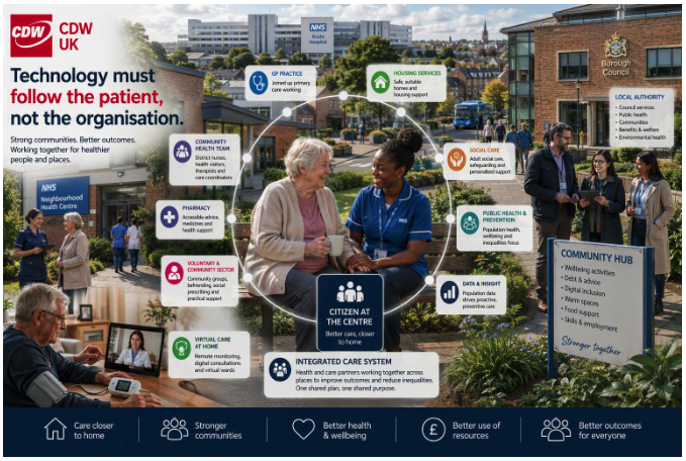
The Centre of Gravity in Healthcare Is Shifting
For much of my career, healthcare technology has been designed around the structures through which care was organised: hospitals, trusts, departments, applications, buildings and individual projects. We built systems to support organisations because that was how healthcare itself was organised.
Yet when I think about the patients I've worked with throughout my career, they rarely thought about care in organisational terms. They thought about their health, independence, home, family and community.
Patients experienced healthcare as a journey, while the NHS too often delivered it as a series of organisational interactions.
I believe that is now changing. The shift towards Neighbourhood Health Services, prevention, community-based care and population health management represents one of the most significant transformations the NHS has undertaken in decades. If healthcare delivery is moving closer to people, technology must do the same. Technology must follow the patient, not the organisation.
The Future of Healthcare Will Happen Closer to Home
The traditional model of healthcare has largely revolved around hospitals. Hospitals remain critical and will continue to play an essential role, but they can no longer be the only centre of gravity for care. Increasingly, NHS policy, workforce planning and service redesign are focused on delivering more care within communities, homes and neighbourhoods.
This is not simply about reducing pressure on acute services. It reflects a broader recognition that health and wellbeing are shaped by housing, employment, social care, isolation, lifestyle, education, income and the availability of preventative support.
The future of healthcare therefore requires a broader ecosystem of partners working together across places rather than within organisational boundaries. NHS organisations, local authorities, primary care, community services, voluntary sector organisations and social care providers must increasingly act as part of a connected system, with technology supporting collaboration across that wider ecosystem.
Technology Was Built Around Organisations. Patients Were Not.
One question I often ask healthcare leaders is:
“How many times does a patient need to tell their story?”
The answer is usually that patients have to repeat their story far too many times. Despite huge progress in digital transformation, many people still experience fragmented services, information and pathways. Information sits in different systems, teams use different applications and processes vary across organisations. Patients move between services while their data struggles to move with them.
The challenge isn't necessarily a lack of technology. It is that technology has often reflected organisational boundaries, while patients experience care as one connected journey. Technology should increasingly enable information, workflows and services to move around an individual regardless of which organisation is involved in their care. Interoperability remains one of the most important foundations for achieving this vision.
Neighbourhood Health Needs Digital Infrastructure
The move towards neighbourhood-based care is often described through new teams, pathways, partnerships and models of care. What receives less attention is the infrastructure needed to support them. Neighbourhood health cannot operate effectively if information remains trapped inside organisations.
It requires shared information, secure data access, digital collaboration, care coordination, population health insight, mobile working and virtual care capabilities. For technology leaders, this means thinking beyond individual systems and considering how information flows across entire places.
The question is no longer simply, “How do we optimise a hospital?” It is increasingly, “How do we optimise a place?”
Remote Monitoring Is Not a Technology Programme. It's a New Model of Care
One of the most exciting developments in recent years has been the growing maturity of remote monitoring and virtual care. For some organisations, remote monitoring is still viewed primarily as a technology initiative, but I think that framing is a mistake. The real value is not in the device itself, but in the model of care it enables.
Remote monitoring can support earlier detection of deterioration, fewer avoidable admissions, care at home, patient confidence, service capacity and more proactive intervention. The technology matters, but enabling clinicians to intervene before a crisis matters more. The future of healthcare is increasingly proactive rather than reactive, and technology becomes valuable when it helps make that shift possible.
Prevention Needs Data, Not Just Good Intentions
Healthcare has spent decades attempting to move upstream. Everyone agrees that prevention is important, but making prevention real requires reliable information and the ability to act on it. Earlier intervention depends on understanding risk, demand, population trends, health inequalities, service utilisation and vulnerable cohorts.
This is where data and analytics become particularly important. Population health management is increasingly allowing systems to identify individuals and communities who may benefit from earlier support or intervention. However, prevention only works when insight becomes action. The challenge is not producing another dashboard, but connecting insight to neighbourhood teams that can act upon it.
Local Government Partnerships Are Becoming Essential
One of the most encouraging developments I am seeing is the growing alignment between healthcare and local government. The challenges facing communities rarely fit neatly into organisational boundaries. A frail older resident, for example, may need coordinated healthcare, social care, housing intervention, community services and family engagement.
Addressing those needs requires collaboration, which is why I believe place-based approaches, devolution and local government reform will become increasingly important over the next few years. Technology has a crucial role in enabling those partnerships, not by creating more systems, but by helping organisations coordinate around shared outcomes.
The organisations that succeed will be the ones that learn to share information appropriately, work collaboratively and focus on citizen outcomes rather than organisational ownership.
What This Means for Technology Leaders
The implications are significant. Technology leaders must increasingly think beyond individual platforms and organisational roadmaps. Does information follow the patient, and can neighbourhood teams access what they need? Can organisations collaborate effectively across a place? Are technology strategies supporting prevention, scalable virtual pathways and care closer to home? Most importantly, are services being designed around citizens rather than organisations?
The most successful technology strategies over the next decade may not be those with the largest investments, but those that remove the most friction from people's journeys through health and care.
How CDW UK Can Help
Many of the conversations we're having with NHS organisations today are no longer focused on individual technology projects. They are focused on transformation and on how digital foundations can support new models of care across organisations and places.
The central question is: how do we enable neighbourhood health in a way that is secure, connected, scalable and centred on the needs of citizens?
That is where CDW UK can help. We can support organisations to move from ambition to action by bringing together advisory, technical, security, data, cloud, workplace and partner expertise around the outcomes they are trying to achieve. In practice, that might mean helping an ICS or provider collaborative assess whether its infrastructure, identity, network, devices, security and data platforms are ready to support care closer to home. It might mean supporting a trust to review how clinicians access information across multiple systems, where friction exists, and what needs to change so information follows the patient more naturally. It might mean helping local government, NHS and community partners shape the digital foundations for place-based services, where teams need to collaborate securely around shared outcomes.
For organisations exploring remote monitoring, virtual wards or more proactive community pathways, CDW UK can help with the practical foundations that make those models work: connected devices, resilient infrastructure, secure access, data flows, integration, service support and adoption planning. The opportunity is not simply to deploy more technology, but to design the operating model around the people who will use it and the citizens it should support.
For organisations looking at AI, automation or analytics, CDW UK can support readiness conversations before technology choices are made. That includes helping teams clarify the problem they are trying to solve, assess data quality and governance, review cyber and information governance requirements, understand workflow impact and define how benefits will be measured. For example, an organisation considering AI-enabled documentation, predictive analytics or pathway automation needs more than a product conversation. It needs confidence that the right clinical safety, information governance, cyber security, data protection and adoption considerations have been built in from the start.
CDW UK can also help organisations make better decisions about cloud, infrastructure and hybrid environments. As more care moves beyond hospital walls, organisations need platforms that are resilient, secure and able to support data, applications and users across multiple settings. That might include reviewing workload placement, strengthening business continuity, improving endpoint and identity security, supporting Microsoft and collaboration environments, or helping teams understand where cloud, on-premises and partner platforms each make most sense.
Most importantly, CDW UK’s role is to help join the dots. Technology programmes often struggle when strategy, procurement, clinical needs, operational workflows, cyber security, data, infrastructure and adoption are treated separately. The value of a partner is in helping bring those conversations together so organisations can make better-informed decisions, reduce duplication, manage risk and focus on outcomes.
If your organisation is thinking about neighbourhood health, care closer to home, virtual pathways, AI readiness, interoperability, cyber resilience or digital foundations for place-based collaboration, this is exactly the kind of conversation CDW UK can support. Speak to your CDW Account Director or contact CDW UK to explore how we can help turn strategy into practical, secure and scalable delivery.