By Phillipa Winter, Chief Technologist, Health & Social Care, CDW UK
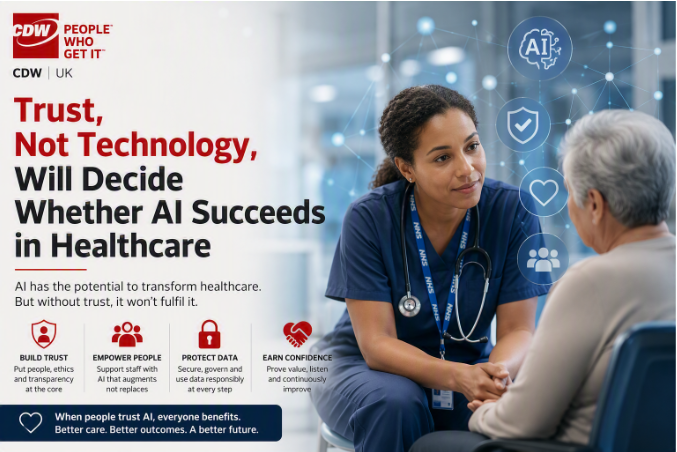
AI will not succeed in healthcare because it is intelligent. It will succeed because it is trusted.
A lesson I've learned repeatedly throughout my career
One of the privileges of my career has been seeing healthcare transformation from multiple perspectives. I've been the clinician completing documentation after the patient interaction. I've been the operational manager trying to create capacity with limited resources. I've been the CIO and CCIO balancing innovation with clinical safety, risk and public accountability. Today, through my work at CDW UK and my wider involvement across health and care, I spend a great deal of time speaking with NHS leaders about artificial intelligence.
What strikes me is that very few of those conversations begin with the technology. They begin with uncertainty.
-
Can we trust this?
-
Is it safe?
-
How do we govern it?
-
How do we explain it to clinicians and patients?
-
What assurance should the board expect to see?
-
How do we know that we are ready?
I think these are exactly the right questions. In healthcare, caution is not a sign that people are resistant to change. Caution is part of how we protect patients. I would be far more concerned if clinicians accepted every new technology without question.
The future of AI in healthcare will not be determined by capability alone. It will be determined by whether the people expected to use it trust it enough to make it part of everyday care.
The real barrier is not capability. It is confidence.
AI is already being used in documentation, diagnostics, scheduling, triage, operational planning and patient-facing services. But access to capable technology does not automatically create adoption.
During my time as an NHS digital leader, I saw excellent technology struggle because people had not been involved early enough. I also saw less mature technology succeed because teams understood the purpose, could see the benefit and felt supported through the change.
If a clinician does not trust an AI-generated note, the clinician will rewrite it. If a recommendation cannot be understood or challenged, it may be ignored. If a board cannot see how accountability works, scale will stall. The most sophisticated system creates little value if it is not used consistently and responsibly.
Confidence grows when people are involved, when limitations are discussed openly and when leaders are visible about where responsibility remains. Trust is not a communications activity at the end of deployment. It is designed into the programme from the beginning.
How is regulation changing?
Regulators increasingly expect proof that operations can withstand and recover from disruption, not just that data is protected. In the financial services sector, the EU's Digital Operational Resilience Act (DORA) applies to UK firms serving EU customers and to the technology suppliers that support them. Where control sits in law can matter as much as where data is physically located. The US CLOUD Act can compel US-headquartered providers to hand over data regardless of where it is stored, prompting many boards to reassess who has legal reach over their information. The concern is significant enough that the EU is examining whether the largest cloud providers should be regulated as "gatekeepers” and has backed its own tech sovereignty agenda.
An NHS case study in earning trust: ambient voice at scale
Great Ormond Street Hospital-led London study
The NHS England-sponsored evaluation of ambient voice technology covered nine London NHS sites and more than 17,000 patient encounters.
- The study reported 23.5% more direct patient interaction time and an 8.2% reduction in appointment length.
- A&E sites reported a 13.4% increase in patients seen per shift.
- Patients and families responded positively, with 92% consenting to use of the AI scribe.
- Clinicians remained responsible for checking and editing the generated note before it was saved to the electronic patient record.
- GOSH states that detailed governance and safety checks were completed before the technology moved into routine use.
For me, the most important lesson is not simply that the tool produced measurable benefits. It is that consent, clinical review, safety checks and clear information for patients were treated as part of the deployment, not as an afterthought.
This is what trusted adoption looks like. The technology supports the consultation, while professional judgement and accountability remain visible. Patients understand what is happening. Clinicians retain control. The organisation can explain how safety, information governance and data use have been addressed.
Governance is not the opposite of innovation
One of the misconceptions I encounter most often is that governance slows innovation down. My experience tells me the opposite. Poorly designed governance creates delay, duplication and late surprises. Good governance gives people the confidence to move.
When clinical safety, information governance, cyber security, data protection, procurement and operational leaders are engaged early, organisations can identify risks before those risks become blockers. When the board understands the risk appetite and the workforce understands the guardrails, adoption becomes easier.
AI governance cannot sit solely with the technology team. It needs multidisciplinary ownership. The governance model should be clear about how AI is selected, validated, deployed, monitored, changed and, if necessary, withdrawn. It should also make clear who is accountable for the output, how concerns are raised and how patients and staff are involved.
For NHS organisations, established clinical safety and information governance requirements still matter. Depending on the use case, this may include Clinical Safety Officer oversight, DCB0129 and DCB0160 considerations, Data Protection Impact Assessments, supplier assurance, cyber controls and post-deployment monitoring.
What NHS boards should be asking
The board conversation has matured. The question is no longer simply, ‘What can AI do?’ It is, ‘How do we adopt it responsibly and demonstrate that responsibility?’
-
Purpose: What patient, workforce or operational problem are we trying to solve?
-
Accountability: Who remains responsible for decisions and outputs?
-
Evidence: What evidence supports safety, effectiveness and value in our setting?
-
Transparency: Can clinicians and patients understand how the technology is being used and where its limits sit?
-
Data: What information is processed, where is it held and how is it protected?
-
Human oversight: How can outputs be reviewed, corrected and challenged?
-
Monitoring: How will we detect errors, bias, drift, incidents and unintended consequences?
-
Adoption: Have clinicians, operational teams and patients been meaningfully involved?
-
Exit: Can the organisation pause or withdraw the technology safely if the risk or evidence changes?
These are not product questions. They are leadership questions. Trust cannot be delegated to a vendor or a project team. It starts with the organisation being clear about its purpose, responsibilities and appetite for risk.
How CDW UK can support AI governance conversations
At CDW UK, our most useful AI conversations rarely begin with a product. They begin with the organisation's ambition, the problem being addressed and the confidence needed to move forward.
The support can bring together the different disciplines that need to be part of responsible AI adoption. Examples include:
1. AI readiness and use-case discovery
Helping leadership teams move from broad AI ambition to a prioritised set of use cases grounded in patient, workforce, operational and financial outcomes.
- Clarifying the problem and intended benefit before technology selection.
- Assessing digital foundations, data quality, interoperability, identity, cyber resilience and workflow readiness.
- Identifying dependencies and risks that could prevent a pilot from scaling.
This keeps the conversation focused on outcomes, not novelty.
2. Multidisciplinary governance design
Supporting organisations to convene the right voices and shape a practical governance approach.
- Bringing together executive, clinical, operational, digital, information governance, cyber security, procurement and workforce perspectives.
- Defining decision rights, escalation routes, evidence requirements and monitoring expectations.
- Connecting AI oversight with existing clinical safety, data protection and enterprise risk processes.
Governance works best when it becomes a clear route to a decision, rather than another layer of meetings.
3. Supplier and solution assurance
Helping NHS customers structure the questions they need to ask before committing to an AI-enabled service.
- Reviewing how suppliers describe intended use, limitations, data handling, security and human oversight.
- Considering integration with the existing technology estate and clinical workflow.
- Making benefits measurement and post-deployment monitoring part of the conversation from the outset.
A strong procurement decision should create confidence beyond go-live, not only at contract award.
4. Safe adoption, change and scale
Supporting the move from a promising pilot to sustainable everyday use.
- Engaging frontline teams and leaders in workflow design.
- Supporting training, adoption and communication around appropriate use and limitations.
- Defining measurable outcomes and reviewing whether benefits are being realised consistently.
- Planning for service support, monitoring, change control and continuous improvement.
The hardest part is rarely proving that AI can work once. It is helping an organisation use it safely, consistently and at scale.
CDW UK's role is not to replace an NHS organisation's accountability. It is to help bring together people, process, governance and technology so leaders can make better-informed decisions and move with confidence.
The future is human-led and AI-enabled
Perhaps the biggest misconception is that AI success means removing human expertise. The NHS examples that interest me most do the opposite. They reduce administrative burden, improve access to information and support decisions while keeping clinicians in control.
The future is not AI versus clinicians. It is clinicians supported by AI, with clear accountability, appropriate challenge and professional judgement at the centre.
Without trust, adoption stalls. Without adoption, benefits are not realised. Without realised benefits, transformation becomes another pilot rather than a better way of delivering care.
A final reflection
Throughout my career, I have watched healthcare adopt electronic records, mobile technology, cloud services, shared care records and virtual care. The pattern is remarkably consistent. Technology succeeds when people understand why it is there, believe it is safe and can see how it improves their work or care.
AI will be no different.
The organisations that derive the greatest value will not necessarily be those with the most advanced tools. They will be those that create confidence: confidence that AI is governed, that risks are understood, that patients are respected and that technology supports rather than undermines professional judgement.
Because ultimately, the question is not whether AI can transform healthcare. The question is whether patients, clinicians and organisations trust it enough to let it.
The most successful AI programmes will not be the ones with the most sophisticated technology. They will be the ones that earn the confidence of the people expected to use it.
Start the conversation
One thing I value about CDW UK's approach is that we recognise successful AI adoption is not a technology project alone. It requires clinical, operational, governance, security and digital teams working together. Through our Health & Social Care specialists, Chief Technology Office (OCTO), Digital Enablement, Data & Cloud, Information Security and AI consulting teams, we help organisations assess AI readiness, strengthen data and digital foundations, develop governance frameworks, address clinical safety and cyber security requirements, evaluate AI use cases, and build the confidence needed to move from pilot projects to trusted, scalable adoption. Whether the challenge is strategy, governance, security, data readiness or operationalisation, we can bring together the right expertise to help NHS organisations adopt AI safely, responsibly and with clear outcomes in mind.
Speak to your CDW Account Director about AI readiness, governance, assurance and adoption, or use the CDW UK contact page to connect with the healthcare team.