Why should the real measure of NHS technology be the time it gives back to clinicians, patients and leaders.
By Phillipa Winter, Chief Technologist, Health & Social Care, CDW UK
The question should not simply be: what does the technology do? It should be: whose time does it give back?
The hidden currency of healthcare
Throughout my career, I have heard the same NHS challenges discussed repeatedly: funding, waiting lists, workforce shortages, demand, productivity, and performance targets. They all matter. But looking back across my journey as an Occupational Therapist, Therapy Manager, Operational Manager, Programme Manager, NHS CIO and CCIO, and now a Chief Technologist working with health and care organisations across the UK, I keep returning to one conclusion.
The most valuable resource in the NHS today isn't money. It's time.
Time to listen properly. Time to think. Time to collaborate. Time to innovate. Time to spend with patients.
When I worked clinically, the challenge was rarely a lack of commitment or knowledge. It was finding enough time for everything surrounding patient care: assessments, referrals, documentation, meetings, handovers and coordination. The irony is that people join healthcare to help people, yet so much of their day can be consumed by work around the patient rather than time with the patient.
That is why I believe every major technology investment should be tested against one practical question: does it release meaningful time for care?
The NHS does not have a technology problem. It has a capacity problem.
The NHS has never had access to more technology: electronic patient records, shared care records, the NHS App, data platforms, artificial intelligence, automation, cloud services, virtual care and remote monitoring. Yet demand continues to outpace capacity.
The February 2026 NHS England productivity update says the Spending Review settlement requires annual productivity improvements of 2% for three years. It also reports productivity improvements of 2.7% in 2024/25 and 2.6% in acute hospitals during the first half of 2025/26. The same plan identifies technology and digital innovation as part of the route to improving productivity beyond the current frontier.
Those figures matter, but they should not become a reason to ask already stretched people simply to work harder. For me, the purpose of digital transformation is to remove avoidable work, simplify pathways, and create capacity.
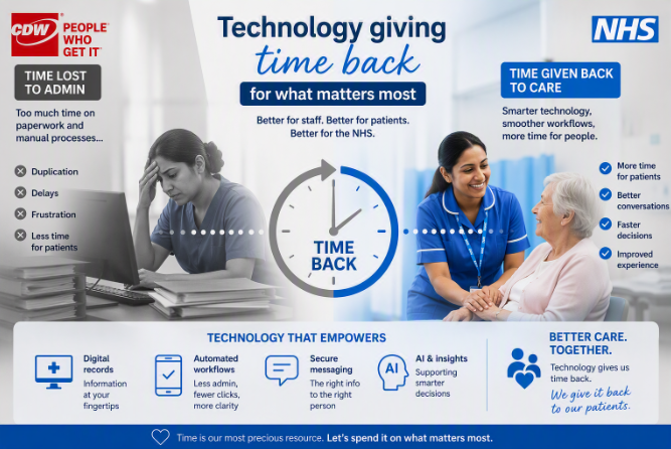
For years, technology programmes have been measured by implementation. We should also ask: how much time did we give back? If a new platform does not reduce friction, improve access or create capacity, we may only have digitised an existing inefficiency.

The administrative burden is stealing time from care
One comment from a clinician has stayed with me: ‘I do not mind working hard. I mind spending my day doing things that do not add value.’
That is the real opportunity for technology. Not replacing the clinician but removing the repetitive and administrative work that gets between the clinician and the patient.
In July 2026, NHS England highlighted results from an NHS England-sponsored study of ambient voice technology across nine London NHS sites and more than 17,000 patient encounters. The reported outcomes included 23.5% more direct patient interaction time, an 8.2% reduction in appointment length and a 13.4% increase in patients seen per shift in A&E.
NHS England also reported that an emergency department pilot at St George's saved clinicians 47 minutes per shift, creating capacity for one additional patient per clinician per shift.

Forty-seven minutes is not just a productivity statistic. It could be an additional assessment, an unhurried conversation, or the difference between completing notes at work and taking them home.
Giving time back improves more than productivity
This is where I think we sometimes misunderstand productivity. It is not only about more appointments, more procedures, or more activity. It is about creating space for what matters.
In August 2026, Digital Health reported results from Central and Northwest London NHS Foundation Trust after it scaled ambient voice technology. The trust reported clinical administration reductions of up to 68% and a 17% productivity increase within six months, equating to around six additional patients per clinician per month.
The same report said staff turnover in pilot sites reduced from 40% to 12%, while sickness absence fell from 2.04% to 0.87%. These are organisation-reported results rather than a universal forecast, but they show why the conversation must go beyond technology features.
To me, those are human outcomes. Less administration can mean more time to listen. More capacity can mean better access. A working day with less friction can mean a clinician is more likely to stay.

The best technology is often invisible
Everyone wants to talk about AI. Fewer people want to talk about Wi-Fi, identity, devices, interoperability, resilient infrastructure, or well-designed workflows. Yet these foundations shape every digital experience on the frontline.
If a clinician cannot connect, must repeat a login, or searches across several systems for the same information; time disappears in small increments. Repeated across a shift, a team and an organisation, the cumulative effect is significant.
The best technology often disappears into the workflow. It supports interaction without competing with it. That is why foundations, integration, and adoption matter as much as the headline of innovation.
AI will succeed or fail on one simple question
There is understandable excitement about AI across the NHS. Some of it is justified and some of it is still hype. My test is simple: does it give time back safely and measurably?
Boards and digital leaders should ask whether technology reduces documentation, releases clinical capacity, improves patient access, supports workforce wellbeing, and integrates safely into the existing pathway. They should also ask who benefits from the time saved and whether any new burden has simply moved elsewhere.
The strongest examples are not impressive because they use AI. They are impressive because they address a genuine operational problem while keeping the clinician in the loop.
The next challenge is adoption
Technology is rarely the whole answer. In my experience, successful transformation depends on people, confidence, and purpose. It needs clinical safety, information governance, cyber security, training, change support, leadership, and honest measurement of benefits.
Adoption cannot be treated as the final line of a technology plan. It is work. If a tool does not fit the workflow, people will not use it consistently. If teams do not understand how decisions are governed, they will not trust it.
The next phase of NHS digital transformation should therefore be less about collecting more pilots and more about scaling what works, learning what does not, and being disciplined about outcomes.
A final reflection
Looking back across my career, the NHS has never lacked talented, committed people. The challenge has always been creating enough capacity around them.
We cannot create more hours in the day. But we can be more thoughtful about how those hours are used. We can remove avoidable administration, connect information, design better workflows, and choose technology because of the outcome it enables, not because it is new.
When we give time back to a clinician, we give something back to the patient too: more time to listen, explain, reassure, and care.
The most successful NHS technology programmes will not be remembered for the systems they deployed. They will be remembered for the time they returned to the people who needed it most.
Ready to create more time for care?
Speak to your CDW Account Director about how technology could support your organisation to reduce friction, release capacity and improve the experience of delivering care.