By Phillipa Winter, Chief Technologist, Health & Social Care, CDW UK
Executive summary
We’re at a different point in the AI conversation across health and care. The question is no longer whether AI has potential. It clearly does. The more important question is whether we can use it safely, responsibly and practically to make a measurable difference for patients, staff and the organisations delivering care.
For me, this is where the conversation needs to move: away from technology for technology’s sake, and towards better access, safer care, less pressure on staff, improved productivity and stronger operational resilience.
AI should not be treated as another standalone digital project. It needs to be understood as a strategic capability shaped by the data it depends on, the governance around it, the workflows it touches, the staff who use it and the outcomes it supports.
What I’m seeing in the market is a clear change in tone. Healthcare leaders are interested in AI, but they are more outcome,focused and more conscious of the foundations needed to make it work. The strongest conversations are starting with pressure points: workforce capacity, clinical documentation, demand management, patient flow, digital maturity, cyber resilience and the need to make existing investments work harder.
AI has moved from experimentation to operational responsibility
For several years, AI in healthcare has been spoken about in terms of promise. Earlier diagnosis. Faster administration. Better patient engagement. More efficient services. Less burden on frontline teams. All of that matters, but the sector is now moving beyond proof of concept. The focus needs to be on where AI can work in real clinical and operational environments, and how we make that safe, trusted and measurable.
That shift is important. When AI is experimental, success is often about whether a tool can demonstrate potential. When AI becomes operational, the questions become harder: is it safe, explainable, governed, monitored and genuinely useful for patients, staff or services?
So, the leadership question is not simply, “where can we use AI?” It is, “where can AI make a meaningful difference, and are we ready to use it well?”
The real question is no longer adoption, it is value
Many health and care organisations have already invested in digital platforms, data, infrastructure, cloud services and electronic records. The next stage is proving value: are those investments helping staff work differently, improving flow, supporting better decisions and strengthening resilience?
AI brings that question into sharper focus. It can accelerate transformation, but it can also expose the gaps we already know exist: poor data quality, fragmented workflows, unclear ownership, weak governance and limited capacity for change.
If we do not define the outcome first, AI risks becoming another layer of complexity. If we do, it can become a practical tool to help solve the problems that matter most.
That is why I always come back to the same starting point: begin with the problem, not the product. Where is the pressure greatest? What is taking time away from care? Where are decisions harder than they need to be? Where could better information, automation or insight make a real difference? Those are the places where AI strategy starts to become meaningful.
In customer conversations, I’m increasingly hearing leaders ask how AI can help them move from reactive service management to more proactive, preventative and population,based models of care reducing pressure on acute services, making better use of workforce capacity and supporting more joined,up decisions across organisations.
Data readiness is the foundation of AI readiness
AI is only as strong as the data, governance and context that sit behind it. That is why data readiness has to be treated as a core part of AI readiness, not as a technical detail to sort out later.
NIST provides a simple way to describe it is this: data is the fuel, and AI is the engine. If the fuel is poor quality, the engine will not perform as expected. It is the same principle many of us used in NHS digital leadership as “garbage in, garbage out”. Good data gives AI a stronger foundation to identify patterns, support decisions and generate meaningful insight.
For healthcare organisations, this makes data strategy a board,level AI issue. AI readiness requires more than access to large datasets. It requires confidence that data is clinically meaningful, appropriately governed, interoperable, secure, representative and usable within real workflows.
The practical lesson is simple: before scaling AI, leaders should understand whether their organisation’s data environment can support safe and reliable use. That includes clinical coding, structured and unstructured records, information governance, data linkage across pathways and the ability to monitor outputs once AI is deployed.
My own view is that many organisations are closer to AI readiness than they realise in some areas, but further away in others. Strong ambition and good use cases help, but the harder questions are often about whether data is trusted, accessible, owned, governed and safe to use across organisational boundaries.
Governance, safety and trust are not barriers to AI, they are enablers
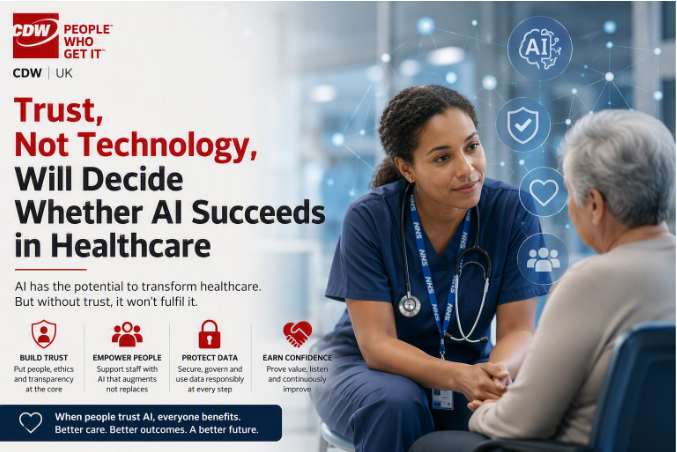
Healthcare AI adoption depends on trust. Patients need to understand how their information is being used. Clinicians need confidence that AI supports rather than undermines professional judgement. Executives need assurance that AI is governed, monitored and aligned with organisational risk appetite.
AI governance cannot sit solely with technology teams. It needs clinical leadership, operational ownership, information governance, data protection, risk management, cyber security, procurement, patient engagement and workforce representation. The governance model should cover how AI is selected, validated, deployed, monitored, updated and withdrawn if required.
A Clinical Safety Officer review should be built into this governance approach from the outset. In health and care, AI,enabled solutions that influence clinical, operational or patient,facing workflows need appropriate clinical safety oversight, including consideration of DCB0129 and DCB0160 where applicable. This helps ensure that risks are identified, assessed, mitigated and documented before deployment and throughout live use.
AI assurance should also connect to the frameworks health and care organisations already use to understand risk and evidence maturity, including the Data Security and Protection Toolkit and, where applicable, Cyber Assessment Framework expectations. AI introduces questions around data access, supplier assurance, auditability, resilience, monitoring and safe recovery, so these need to be part of the same governance conversation.
One of the strongest market signals I’m seeing is that boards want assurance, not just ambition. They want to know who is accountable, how clinical safety is managed, how benefits are evidenced and how risks are monitored once a solution is live.
Workforce impact should be a primary measure of success
AI strategies in healthcare often start with technology capability, but they succeed or fail in the hands of the workforce. Technology adoption should be judged on its ability to reduce clinician burden, improve frontline productivity and enhance patient outcomes.
This is particularly important in the NHS, where workforce pressure, demand management and operational resilience remain central concerns for digital leaders. AI should not be introduced as another system for staff to manage. It should be designed around real clinical and operational pain points.
AI adoption is a change programme, not just a technical deployment. The organisations most likely to create value will involve clinicians, nurses, allied health professionals, administrative teams and operational managers early. They will focus on workflow integration, not just model performance, and measure whether AI reduces friction, supports better decisions, improves flow and gives time back to staff.
Having worked in the NHS as both a clinician and digital leader, I know technology only lands well when it makes sense to the people delivering care. Staff do not need another system that adds clicks, alerts or friction. They need technology that removes avoidable burden, supports safe decision,making and gives time back where it matters.
Cloud and infrastructure matter because AI outcomes depend on them
Cloud, infrastructure and hybrid technology models matter because AI outcomes rely on the right digital foundations. As organisations review the value of previous digital investment, the focus needs to be on cost transparency, workforce capability, secure data access and workload placement based on the outcomes the organisation wants to achieve.
Hybrid strategies may remain important where organisations need to balance performance, cost, security, latency, data governance and legacy system integration. Infrastructure decisions should be linked to the outcomes the organisation is trying to achieve, rather than treated as purely technical architecture choices.
AI changes the value conversation around cloud. The question becomes less about migration for its own sake and more about whether digital platforms can turn data into timely insight, support operational resilience, scale proven use cases and measure impact.
Across the market, I’m seeing more organisations revisit cloud and infrastructure decisions through the lens of AI, EPR readiness and regional collaboration. The question is less about where a workload sits in isolation, and more about how platforms, data, networks and security support care pathways across trusts, systems and settings.
Backup and business continuity also need to be part of this conversation. As AI becomes more connected to clinical, operational and administrative workflows, organisations need confidence that critical data, systems and services can be protected, recovered and kept available when disruption happens.
The aim is not simply to protect technology; it is to protect the ability of staff to continue delivering care safely when systems are under pressure.
What healthcare leaders should do next
The next phase of healthcare AI requires a practical leadership agenda that connects ambition to measurable value.
From my perspective, the organisations that will make the most progress are not necessarily those with the biggest AI ambition. They will be the ones that are honest about their starting point, focused on a small number of high,value problems, and disciplined about evidence, governance and adoption.
1. Start with the outcome, not the algorithm
AI programmes should be anchored in clearly defined clinical, operational or workforce outcomes. The aim should be to move from technology adoption to measurable value, and from isolated projects to enterprise,wide transformation.
Leaders should ask:
-
What problem are we trying to solve?
-
Who experiences that problem today?
-
What measurable improvement would matter?
-
How will we know whether AI has helped?
-
What unintended consequences must we monitor?
2. Treat data quality as a strategic dependency
Data quality, governance and accessibility are core dependencies for AI and digital transformation. AI output quality depends directly on the quality of the underlying data.
Leaders should assess:
-
Whether data is accurate, complete, consistent, relevant, and timely.
-
Whether data can be linked across care settings.
-
Whether information governance is clear and usable.
-
Whether data reflects the populations the organisation serves.
-
Whether monitoring is in place once AI is deployed.
3. Build governance that is multidisciplinary
AI governance should include clinical, operational, technical, information governance, legal, safety, procurement and patient perspectives.
Leaders should define:
-
Who approves AI use cases.
-
Who owns clinical safety.
-
Whether a Clinical Safety Officer review is required, and how clinical risk management will be documented.
-
How AI adoption aligns with DSPT, CAF, supplier assurance, cyber resilience and wider organisational risk management.
-
Who monitors model performance.
-
Who reviews equity and bias risks.
-
Who is accountable for post,deployment oversight.
4. Design for the workforce from the beginning
Clinician burden, productivity and patient outcomes should be treated as core measures of technology success. Staff confidence also depends on whether teams understand the purpose of AI, see evidence of effectiveness and feel able to shape how it is used.
Leaders should involve staff early in:
-
Problem selection.
-
Workflow redesign.
-
Usability testing.
-
Training and communications.
-
Evaluation of real,world impact.
5. Connect AI strategy to digital foundations
AI, data, cloud and infrastructure should be viewed as connected parts of the same transformation agenda. Workload placement, platform strategy and digital investment should be guided by the outcomes the organisation needs to deliver.
Leaders should review whether their digital foundations support:
-
Secure access to data.
-
Interoperability across pathways.
-
Scalable analytics and AI workloads.
-
Cost transparency.
-
Operational resilience.
-
Backup, recovery and business continuity.
-
Continuous monitoring and improvement.
Conclusion: the next phase of healthcare AI is about disciplined value creation
The next phase of healthcare AI is about disciplined value creation. It depends on the fundamentals that determine whether digital investment creates real value: clear strategy, trusted data, strong governance, clinical engagement, workforce adoption, secure infrastructure and disciplined measurement.
For healthcare leaders, the opportunity is significant, but the route to value needs to be intentional. AI should not be treated as a collection of disconnected tools or pilots. It should be developed as an organisational capability, governed responsibly, connected to data and workflow, aligned to clinical priorities, and measured by its impact on staff, patients and operations.
The organisations that make progress will be those that ask harder questions earlier: not simply “what can AI do?”, but “what outcomes matter, what foundations are required, who needs to trust it, and how will we prove value in practice?”
For more information, or to continue the conversation about how to turn AI ambition into practical outcomes for health and care, please get in touch.