What if I said “AI is your new operating System”?
Microsoft’s latest Windows announcement reinforces a direction we at CDW have been helping customers prepare for: the PC is evolving from a place where apps run, to a secure orchestration layer for AI-enabled work.
As agents become part of everyday productivity, the enterprise question is no longer simply “which AI tool should we use?”
It is:
-
Where do agents run?
-
What can they access?
-
How are they contained?
-
How do we govern, monitor, and trust their actions?
That is why Microsoft’s focus on Windows for hybrid intelligence, Microsoft Execution Containers, local and cloud model orchestration, identity, manageability, and agent governance is so important.
We have seen AI as a bolt-on feature, or a capability magically appearing in an application, this is not that, this is a strategic redesign of where and why AI is placed on the endpoint. It is the emergence of a managed operating environment for intelligent work, one where agents can act locally or in the cloud, but within the security, policy, and compliance boundaries organisations need.
The visual below captures the shift well: Windows is no longer just running apps. It is becoming a secure platform for orchestrating agents, data, permissions, monitoring, and outcomes.
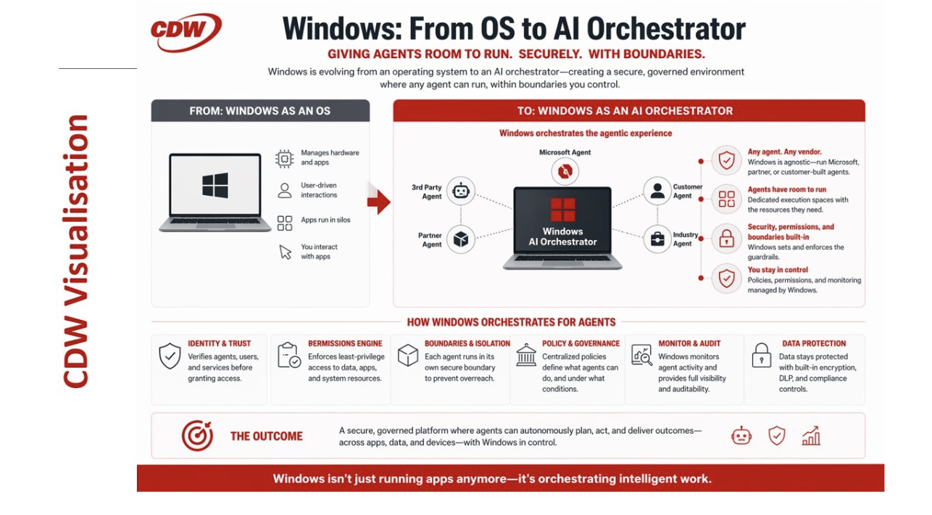
For CDW, this validates the conversations we have already been having with customers: AI adoption is not just about experimentation. It is about readiness; across devices, data, governance, security, user experience, and change.
I have mentioned this before but the biggest spenders or the organisations with the most agents are not necessarily the ones that will move the fastest. They will be the ones that are ready to give users the safe space to run agents, visibly, and with purpose.
How does this fit into the Big Picture?
These announcements and the direction we are seeing aligns with a lot of the recent pivots from Microsoft and trends we are seeing generally across the technology sector.
Copilot Home, Code and Autopilot
A few weeks ago Microsoft talked about bringing different modes of work into one Copilot experience; Home which combines Chat through Cowork, Code and Autopilot (A reuse of this name is causing some confusion!). The significance, when seen in the mix of all the other announcements, is not simply a new interface, but a shift from AI as an assistant you prompt to an operating layer through which people can ask, delegate, build and automate. Having being an active user of Scout, a Microsoft frontier end user AI agent I am very excited about how this will change the end user experience, but there are caveats (Covered later).
Microsoft IQ and Fabric IQ
Agents are only useful when they understand the language, data and operating context of the organisation. If you have access to Microsoft IQ you will understand the intelligence, insights and value it can bring to an individual and a business, combined with Microsoft Fabric IQ bringing governed business context into Copilot. What this means is that responses and actions are grounded in trusted semantic models, metrics, relationships and business definitions. Fabric IQ in Copilot Chat and Cowork is generally available, with integration into the new Code experience coming soon in the Frontier programme. You may already have it available in your enterprise, if not it should be available to use soon. A slight side note I have found in using IQ as an individual, is to ask it to roast your week; try it, and humour aside, you will find immense value in it!
FinOps for AI
Organisations may want to see the detail of every user prompt to understand how AI is being utilised and adopted, this isn’t possible, thankfully, so a humorous image request may remain private, for example, while its consumption and business impact can still be measured. At a higher level, through FinOps for AI, usage patterns can show whether AI is supporting chat, automation, content creation or in-depth analysis, and how each activity contributes to the cost base. This gives leaders the visibility to distinguish experimentation from scaled business use, manage demand responsibly and connect AI investment to productivity, process improvement and measurable value. AI is well past the experimentation stage, businesses need to see the value and the RoI, especially with license and tokenomic costs as well as hardware refreshes involving end user AI (AI PC and Copilot+)
What leaders should watch next
The direction of travel is clear: Windows, Copilot, agents, local compute and cloud intelligence are beginning to converge into a new operating model for work. That is exciting, but it also creates a set of leadership questions that organisations should be thinking about now.
Tokenomics and cost control will become more important as AI moves from simple prompts to long-running agentic work. The economics of “ask a question” and “delegate a task” are different. Leaders will need visibility of consumption, value, controls and chargeback models so AI spend is managed as an investment, not treated as an unpredictable overhead. Think FinOps for AI.
Licensing models will need careful navigation. As capability spreads across Copilot, Windows, agent runtimes, premium features, local models and usage-based billing, organisations will need to understand what is included, what is metered, and where different roles genuinely need different levels of access. Think Licensing optimisation, and that it’s not always a case of one size fits all.
User enablement remains critical. The technology may become more autonomous, but business value still depends on people knowing when to use AI, how to delegate effectively, how to review outputs, and where human judgement must remain in the loop. Adoption is not the same as transformation. Think anyone can use AI, sometimes without realising, how do we enable users to use it in a way that maximises their productivity.
Local data and local actions introduce new considerations. Hybrid intelligence has real advantages: responsiveness, context, resilience and potentially better cost efficiency. But it also raises questions about device-level governance, policy enforcement, endpoint security, and the boundary between personal, local (on device) and corporate data. Consider if an on device agent can access your bank account, should it, when will you trust it with this level of access?
Device resilience will matter more. If the PC becomes part of the AI execution layer, then endpoint health, performance, lifecycle management, backup, recovery and security posture become directly tied to AI productivity. The device is no longer just an access point; it becomes part of the intelligence fabric. How are you managing this now?
Device dependency must be managed carefully. Local AI capability will not be uniform across every endpoint. Organisations will need to plan for mixed estates, varying silicon capabilities, refresh cycles, and equitable access to AI experiences across different roles and locations. If you replace an NPU powered device with a device that doesn’t have one, will this impact a user’s productivity?
The opportunity is significant, but the lesson is familiar: the organisations that benefit most will not simply be those that adopt the newest AI features first. They will be the ones that pair innovation with governance, enablement, commercial discipline and a clear view of operational readiness.
That is where the real work starts.