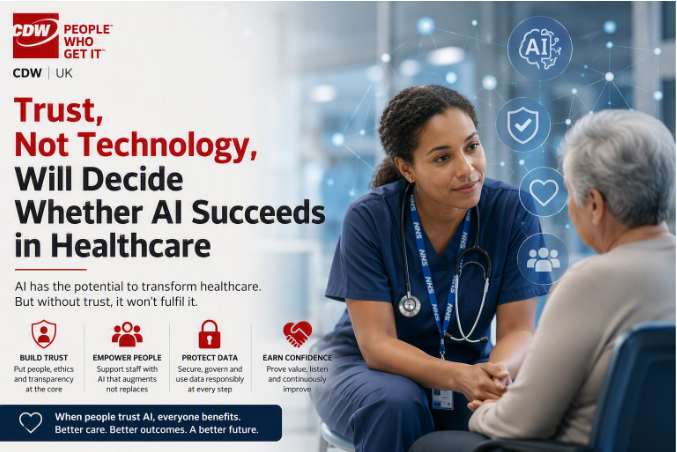
 Reflections from the KLAS Global Summit 2026, Dubrovnik — a CDW UK perspective for healthcare leaders
By Phillipa Winter, Chief Technologist, Health & Social Care, CDW UK
Why this conversation matters
The KLAS research Global Summit this summer brought together a focused group of healthcare CIOs, clinical informatics leaders and strategic partners from across the world. On day two, I had the privilege of moderating a conversation that went straight to the heart of where many organisations are right now: after years of digital and cloud investment, are we genuinely seeing the impact we set out to deliver?
The honest answer in the room was, not consistently enough yet. For me, that is not about a lack of ambition. It tells us the conversation has moved on. We are no longer talking simply about adopting technology. We are talking about measurable outcomes, enterprise-wide change, and value that is led by clinical and operational need rather than by the technology itself. That shift is particularly clear when it comes to AI.
AI has moved from experiment to operations
The clearest message from the summit was that AI has moved beyond the innovation lab. Leaders were talking about real deployments in live clinical and operational environments, and with that comes a very different set of questions. It is less about whether AI is interesting, and more about whether it is safe, governed, trusted and delivering a better pathway than the one it replaces.
That maturity is encouraging, but it also raises the bar. A pilot can get by on energy and goodwill. A live AI service needs clear ownership, clinical accountability, monitoring, information governance and a sensible way to stop or change course if it is not delivering. The organisations making the most progress are treating AI as a managed capability with a lifecycle, not as a tool they have simply bought and switched on.
Data decides how far your AI can go
Every AI conversation came back to data. Data quality, governance and access are still the things that either unlock progress or hold it back. When organisations have a clear data foundation, they can move from idea to deployment with more confidence. When they do not, every new use case reopens the same questions about provenance, consent, structure and access.
There was also a strong focus on hybrid and real-time data strategies. The key point for me is that data placement is no longer a back-office technical decision. Where data sits, how quickly it can be accessed, how it is protected and what it costs to move all now shape whether AI can work safely and practically at scale.
Cloud value is under scrutiny, and AI is the reason
Many organisations have made significant cloud investments, but the value is now being examined more closely. AI is accelerating that scrutiny. These workloads need large volumes of data, reliable architecture and careful cost control. They quickly expose where decisions about workload placement, skills, governance and funding have not yet been joined up.
The strongest organisations are asking a better question than “cloud or on-premises”. They are asking: what needs to run where, why, at what cost, and how does that support our clinical and operational goals? That is the kind of decision-making discipline that turns cloud from a destination into an enabler of value.
A second wave is now underway
A second wave is also emerging. Mid-market and regional providers are moving quickly on electronic patient record programmes, data platforms and AI capability. In the UK, this feels very relevant to trusts and integrated care systems, where the real work is often about convergence across organisations. The opportunity is to learn from what has already worked elsewhere, and avoid repeating expensive detours.
Workforce and clinical impact are the measure that counts
Technology is increasingly being judged by three very human measures: does it reduce the burden on clinical teams, improve productivity, and support better patient outcomes? AI should be held to exactly the same standard. The examples that resonated most were not the ones with the most impressive model behind them. They were the ones giving time back to teams, improving flow or supporting better decisions.
Skills and confidence matter here. The same technology will land very differently depending on whether people understand it, trust it and feel involved in the change. Workforce capability is not a “nice to have” alongside AI. It is one of the conditions for value.
A candid conversation among peers
The panel brought together international perspectives from senior digital leaders across major European academic health systems and UK peers. What made it valuable was the honesty. People talked about what had worked, what had not, and where AI ambition meets the reality of running complex health and care services. That openness was exactly why the conversation continued well beyond the formal session.
UK representation was strong, including leaders from acute trusts, mental health trusts, integrated care systems and NHS England regional leadership. For me, the value of a forum like KLAS is the peer-level honesty it creates. It gives leaders space to test their thinking, share the messy middle, and learn from each other without the conversation becoming a sales pitch.
What this means for your organisation
CDW attended the summit alongside our partner Dell because this is exactly the gap we help healthcare organisations close: the gap between investment and impact. Dell brings the infrastructure, cloud and AI-ready platforms that make demanding workloads practical. CDW brings the advisory, integration and lifecycle services that connect strategy to delivery and help keep momentum beyond the initial investment.
In practice, that means helping organisations move from cloud consumption to cloud value, and from AI experimentation to safe, governed AI in service. That support typically focuses on four areas:
-
Clearer workload decisions based on clinical need, performance, cost and risk.
-
Data readiness that can stand up to real AI use cases, not just strategy documents.
-
Secure hybrid adoption that reflects where data, applications and users actually need to be.
-
Infrastructure readiness so clinical demand does not arrive before the environment can support it.
Five questions worth answering next
If there is one thing I would take from the summit, it is the importance of asking better questions before making the next investment decision. These five are a practical place to start. Each one can lead to a first step in weeks, not years.
|
Focus area |
The question to answer |
A practical first step |
|
AI in operation |
Which of our AI use cases are running in live service, and who is accountable for their safety and performance? |
Inventory every AI capability in use, including those embedded in existing systems, and assign clinical and technical ownership. |
|
Data readiness |
Could our data support the next AI use case without a six-month remediation project? |
Run a readiness assessment against one priority use case, covering quality, governance, access and lineage. |
|
Cloud value |
What return have we actually realised from migration, and where is spend outrunning benefit? |
Establish FinOps visibility and review workload placement against outcome, cost and latency. |
|
Infrastructure for AI |
Is our compute, storage and network ready for AI-scale demand, including at the point of care? |
Model the infrastructure implications of your top three AI ambitions before committing to them. |
|
Workforce capability |
Do our clinical and technical teams have the skills and confidence to adopt what we deploy? |
Pair every AI deployment with a named clinical sponsor and a defined enablement plan. |
Continuing the conversation
KLAS remains one of the few forums that combines executive access, strategic discussion and evidence-based research into how technology is performing across global healthcare. The themes above are not abstract predictions. They reflect the challenges leaders are already working through.
If any of this reflects a question your organisation is wrestling with — whether that is proving the value of cloud investment, preparing infrastructure for an EPR programme, or moving an AI use case from promising pilot to safe, governed service — I would welcome the conversation.