Humanising IT is becoming a hot topic among the Service Management community, and there are several very good reasons for it:
-
People are your most valuable assets (Insperity, Indeed, Lead Diligently)
-
Businesses typically spend between 40% to 80% of their gross revenue on employee compensation, which includes salaries, benefits, and training (US Bureau of Labor Statistics)
-
Gen-Z expect modern tools and digital efficiency (Corporate Navigators)
-
79% of Millennials and Gen-Z said that an increase in recognition rewards would make them more loyal to their employer (SHRM)
-
70% of framework adoption programs fail (Paul Wilkinson)
-
End-user perceived lost work time per reassignment has increased (HappySignals)
-
72% of IT workers believe the Service Desk as we know it will cease to exist in the next 3 years (Nexthink)
-
The probability of a recession taking hold by the end of 2025 is 45% (J.P Morgan)
-
43 % of Millennials and 78% of Gen-Z plan to leave their job within the next two years (SHRM)
-
Nearly all CEOs believe that GenAI will boost productivity, 99% of organisations are planning further GenAI investments, 80% of organisations aim to enhance process adherence and regulatory compliance through GenAI, yet 90% said legacy infrastructure hinders effective use of GenAI (NTT Data)
The statistics above are unlikely to make one think twice when presented individually. However, when combined, they start painting a picture of the future of the business landscape and give Service Management leaders clues about how to prepare for it.
Humanising Service Delivery is one of the hottest topics in the industry, but what does it mean?
It’s the application of human-centric design to drive cultural, process, and technological change in Service Management. This encourages proactive communication, builds empathy, and optimises service accessibility, trust, and security while considering ethics and encouraging collaboration and continuous improvement.
If the above seems like “fluffy talk”, let’s explore further, considering some key audiences benefitting from it:
Humanising IT – Business View
It all starts with the business and its point of view. At the end of the day, they are paying for the services delivered and, therefore, demand a good return on investment (ROI). As Mark Smalley argues, Value = Benefits – Costs. While the costs may be clear on both sides, the value definition often differs by the business and the service management.
One key consideration for Service Management leadership is understanding what drives the business, its goals, and what the key stakeholders and budget holders care about on both company and individual levels (e.g. career promotion).
In her talk The Unfair Expectations of ITSM, Katrina Macdermid argues that “the role of Service Management is not to design, consider, and manage UX but to manage technology and automate business transactions.” Whilst controversial for ITIL purists, it shifts the focus from outputs to business outcomes, helping Service Management leaders to focus on delivering what the business expects of them rather than sticking to the comfortable cocoon of IT jargon and SLAs.
When building a business case to get a budget to help humanise IT, what are the key considerations?
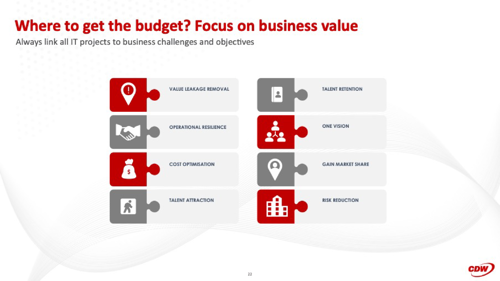
To some Service Management Leaders, the above may seem too abstract when connecting it with their day-to-day job. What questions should they ask themselves and their teams to start understanding the value they need to bring and identify the gaps in their service delivery? What do we ask to start humanising IT from the business point of view?
-
Enhancing efficiency and productivity
-
How can you measure the productivity impact IT has on your employees without understanding their sentiment?
-
Facilitating innovation and competitiveness
-
How can IT decide on what innovation will provide the biggest efficiency and productivity gains without speaking to the end users?
-
Supporting Decision-making
-
What data is IT using to support its decisions?
-
Improving employee experience
-
How can IT understand how to best improve customer experience with a survey only 3-7% of employees respond to?
-
Ensuring security and compliance
-
How can IT understand its impact on the level of employee engagement and satisfaction and whether it’s improving, and therefore increasing compliance and reducing risk?
-
Enabling remote work and collaboration
-
How can IT enable remote work and collaboration in a way that is best for the end users without understanding the end user?
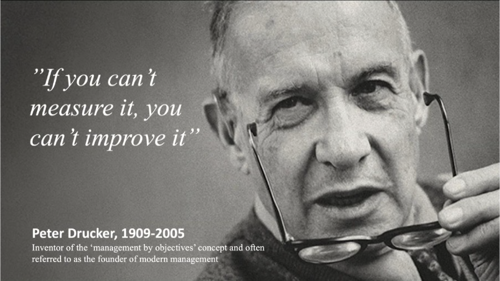
Indeed, as Peter Drucker famously said: “If you can’t measure it, you can’t improve it.”
Humanising IT – Tech Leadership View
The measurement will inevitably fall into the arms of the technology & transformation leaders, whether in IT or other teams such as HR. Currently, most organisations send out a survey either at the end of each ticket or once or twice a year, typically receiving somewhere around 3-7% response rate. Those who respond are usually the extremes - very unhappy and very happy customers/end-users, meaning up to 93% of opinions are not heard, processed, or actioned. Moreover, if all end users were to respond suddenly, there would be no capacity to process the quantitative and qualitative data or to do anything with it. This is where many customer-centric initiatives fail – high dependency on human resources and manual processing and why the market has been booming with DEX and ITXM platforms, tools, and features that automate the vast majority of the process.
Human-centric IT, XLAs and ITXM are clearly making their way through the market, shifting in MoSCoW Requests for Procurement (RFPs) from “Could have” to “Must have” as more and more leaders begin to understand its key value in removing the Watermelon Effect.
Despite what the vendors may tell you, even if you get the most-awarded, Gartner-approved technology, you will not realise the full (if any) value from it. Humanising IT requires a cultural and process shift, a structured approach with a clear vision, milestones, and experienced advisors to help you successfully design and deliver continuously improved service experiences. It is why Paul Wilkinson cannot retire fully – his set of ABC cards and the 8-Field Model, are just as relevant as they were two decades ago because we apply the Continual Ignorement Model (Pressure, Deny, Complain, Apply) instead of focusing on customer value, collaboration, flow, continual learning and improving. How many Service Management leaders can say they allow IT to spend every Monday with end users in different parts of the organisation?
As Neil Keating pointed out at the itSMF Czech Republic conference earlier this year, if you do not speak to your customers, your designed service will likely deliver very different value from what you and the customer expected. Opening those communication channels, aligning the language, and building rapport…all take more time and effort than acquiring a piece of shiny new software, but they are the key to ROI. Perspective is key to success.
Humanising IT – Agent View
The agents are the often-forgotten audience to consider when driving continual improvement in Service Management.
-
What drives them?
-
What difference does (not) hitting an SLA make to them?
-
What do they (not) enjoy?
-
Are they motivated?
-
Are they happy?
-
Do their tools make them more productive?
-
Can they focus on delivering the desired level of service experience?
-
Do they fear being replaced by Agentic AI?
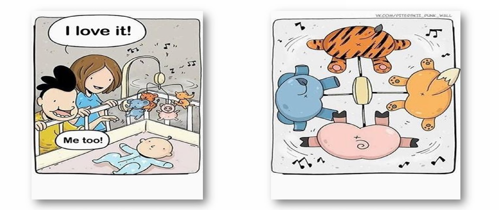
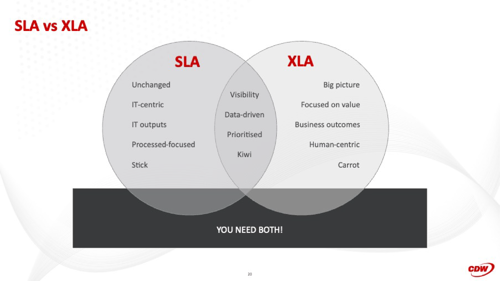
As the world shifts toward the Experience Economy, we must not forget to bring the agents on the journey and ensure they understand what good looks like. If they were professionally brought up in a highly SLA-focused environment, they are likely the ones unintentionally amplifying the Watermelon Effect. However, at the same time, they are your key partners in turning that watermelon into a kiwi when XLAs are introduced.
How?
-
Understanding the broader goals of the business and their department
-
Understanding the business value they deliver
-
Understand how best practices (ITIL, agile, DevOps, IT4IT etc.) can be applied to deliver value to the business
-
Understand how their customers feel (empathy)
-
Understand why their customers feel the way they do
-
Understand they are not there to make people happy but to make them feel comfortable with their work experience and enable them to be productive again
-
Understand how their customers operate when they encounter a problem
-
Understand the different types of customer profiles they are likely to encounter
-
Provide them with appropriate tools and training
You may notice that most of the above has nothing to do with tools but with culture and processes. While the Service Management leadership is busy replacing ESM platforms, understanding how to increase productivity with GenAI-powered Virtual Agents, Summarisation, or adopting NLU/NLP for reporting back to the business, they are losing their biggest assets: the talent working for them.
Luckily, organisations that have successfully introduced Human-Centric Design and Continuously Improved XLAs into their work practices have experienced the cultural shift and its immense benefits.
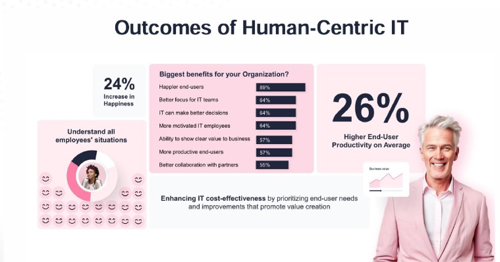
Source: www.HappySignals.com
Humanising IT – Customer/End-user View
Did you get a green light from the business to start Humanising your Service Delivery? Great! It all begins with where we are now. Understand your business, your agents, and your customers/end-users. Hand up if you are guilty of designing your experiences for a single user, not personas.
Do they like to resolve tech issues themselves, or do they prefer to call for help as soon as they lose their productivity? The end-users should define and self-assess each of these types so that the agents know how to approach the conversation best.
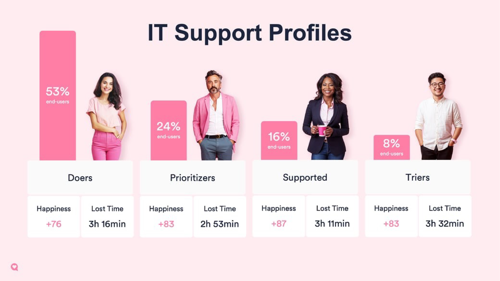
The next step is to set up an automated system to interact with the customers/end-users regularly. It needs to take minimal time to fill out and provide valuable quantitative and qualitative data that is then automatically processed for sentiment and productivity metrics. The output is a report that highlights gaps in service delivery and opportunities for productivity gains. End-user data-driven prioritisation for Change and Problem Management. Who knew? As always, be careful of “XLA Washing” – with every hype comes a set of service providers and vendors that claim to be “doing XLAs” but can barely spell it.
Now that we know where we are, we can start setting out continuously updated XLAs (unlike SLAs with their average lifetime of 31 years) and work with Humanising IT frameworks to continue driving the adoption of a Human-Centred Design in designing Service Management experience – like the one below from HIT:
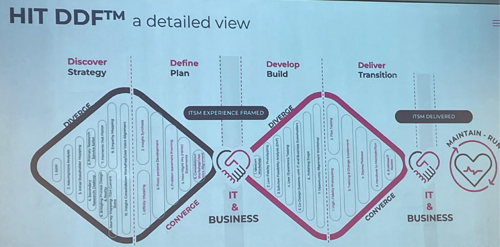
Source: HIT
Once you are on the path to culturally adopting Human-Centred Design in Service Management, you can optimally design and execute automated workflows to achieve a Zero-Ticket future from the point of view of your customers/end-users. Before we get to 2030, we should all fully understand that by the time they need to raise a ticket, we have already failed them. Not Reactive, not Proactive, but Predictive Service Management is the clear future that will kill self-centric IT. Are you ready for it?
Contributors
-
 Jaro Tomik
Chief Technologist - Digital Enablement