Introduction
Let's start with a somewhat controversial opening to this article; just like in the Matrix when Neo is confronted with the spoon to be told “there is no spoon”, I believe there is no real AI. The term AI has become an all-encompassing term with so many different meanings that it is hard to understand exactly what AI means now. We are suffering from AI confusion, AI hype and AI overload. In this article, I want to help you understand the why, how and why not of AI in the Modern Workspace. To do this, I will share a perspective of the conversations I am having with customers, end users, suppliers and manufacturers, where I try to simplify the message, the decisions and the rationale of what we know as AI. I will add to this some of the specific messaging and summaries I have used to help create clarity in these discussions. I will use the term AI throughout, but hopefully, with the contextual information I supply, you will start to understand how this is more than just AI.
This article aims to provide clarity around , helping you understand its true essence, practical applications and how it can harmonise and empower the modern workspace. By demystifying AI, this article aims to simplify your decision-making process and guide you through the initial steps: Build or Buy, Positioning, and Purpose. The goal is to enable you to make informed decisions that align with your organisation's goals, allowing you to leverage AI to its fullest potential and create a more productive and innovative work environment.
Article outline and purpose, Why you may want to read further…
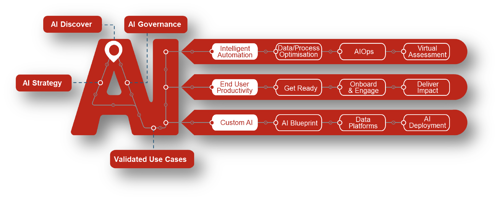
At the first stage of your AI journey, you will decide if this is an Intelligent Automation, Custom AI or an End User Productivity Journey. This document is focused on the End User Productivity Journey and specifically the utilisation of Off-The-Shelf capabilities. The image below is taken from the CDW AI strategy guide and highlights where this eBook and its content belongs.
There are four focus areas that are covered in this article, as shown below.
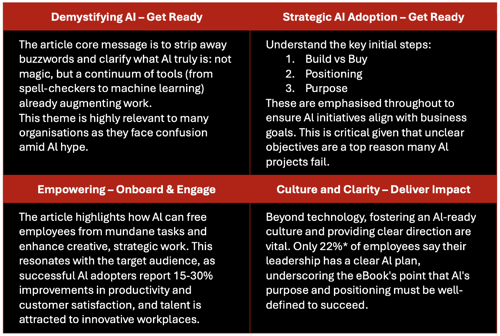
* According to Gallup’s 2025 poll, 44% of employees say their company has started using AI, but only 22% feel leadership has articulated a clear purpose for it.
Data | Driven | Decisions
When we look at the utilisation of off-the-shelf AI, I’ve found it easiest to focus on three pillars. I will walk you through this to help explain how we can rationalise and simplify some of your AI decisions. Before I do that, let's look at the purpose of AI. At its highest level, AI is there to help us make the best-informed decisions we can, quicker and with the widest usable data set. That’s it, and I’ll repeat that, AI in its primary role is there to help us make the best possible decisions with the data we have. Whether we have agentic AI and give AI the ability to make decisions on our behalf, it still comes back to making the most informed decisions with the largest possible relevant data set.
Data: You own your data. Before you embark on your AI journey, you need to be sure it is secure, reliable, and relevant. You also need to ensure that you have the data you need to reach the outcomes you desire.
Driven: This is all about where you want to go with the data you have. What am I trying to achieve? Operating efficiency, productivity improvements, etc.
Decision: When you know what you have (Data) and where you want to get to (Driven) you can then decide on the platform that best helps you reach the outcome with the data you have.
By using these three simple steps, your off-the-shelf AI journey will be easy to plot. This will allow you to ask the right questions and drive towards the best-fit solution.
Whether you build or buy, industry or segment, AI is there to help you make more accurate, quicker decisions that will achieve your organisation's desired outcome.
Positioning: Strategic Placement in the Organisation of your Workspace AI Solutions
An important consideration is where and how AI should live within an organisation’s structure and strategy. Instead of viewing AI as a siloed IT project, I would advocate integrating it into the business with proper positioning. This entails executive sponsorship, cross-functional collaboration, and alignment with company goals. The relevance of this point is evident: studies show companies achieve better AI outcomes when leadership is actively involved and sets clear direction. Gallup’s survey indicates employees are three times more likely to feel prepared for AI when leaders communicate a clear AI strategy
Currently, only about one-fifth of employees strongly agree that the AI tools they use are beneficial, often because these tools are introduced without context or training. If you treat AI as a strategic business initiative, not just a tech experiment, this will determine whether an AI pilot program fizzles or flourishes. Poor organisational positioning (e.g. lack of stakeholder buy-in, unclear ownership) often leads to AI projects stalling. Ensuring AI efforts are championed and embedded in the right departments will help drive adoption and value.
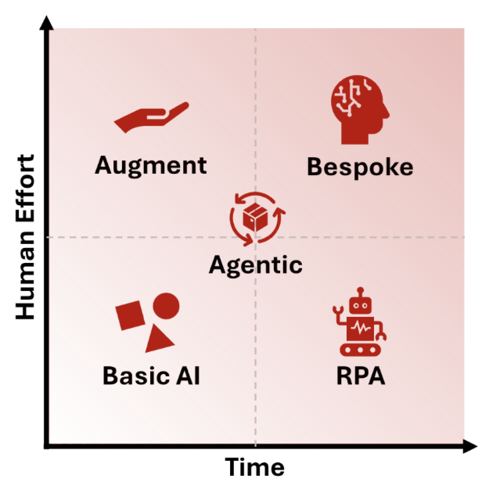
Understanding the type of AI and the outcome it will deliver is also important when we look at positioning. The diagram here I have used and tuned in multiple engagements over the years to help explain how Off the Shelf AI in the Modern Workspace can be simply positioned. I Its simple interpretation can help you understand what sort of AI you are using, and by association, where in your business it can best be utilised. The vertical axis is a reference to human complexity or level of human input required, when plotted against the horizontal base which refers to the time it takes to carry out a function.
- Basic AI as I have termed it here is the use cases we see already and have utilised for years, email reply, spellchecker, grammar etc.
- Robotic Process Automation or RPA, again relatively new to the fold but no more than an extension of if this, then that. These rules are fairly simple and do not require a high level of cognitive power.
- Augmentation is the prime use case we are seeing in use today, especially in the generative space. These use cases require human prompting for creation but ultimately increases our productivity by helping us design, process, analyse or research far quicker by utilising an AI tool.
- Agentic AI is something that builds on the Augmentation capability, but where we are more willing to release control into our Bot or Agent and allow it to make informed decisions on our behalf.
Purpose: The Why of AI.
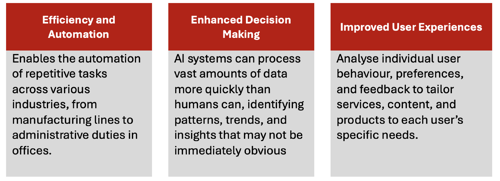
Perhaps the most crucial message is urging you, the readers, to start with “Purpose” – in other words, clearly define what you want to achieve with AI. Identifying concrete business problems or goals before diving into AI implementation is paramount. This advice directly addresses one of the biggest causes of AI failure: pursuing AI for its own sake without a problem-solution fit. Research supports this: a Gartner study found nearly 85% of AI projects fail to deliver due to factors like poor data quality and, tellingly, lack of clear objectives.
Successful AI initiatives almost always begin by pinpointing a use case where AI can make a measurable impact. For instance, reducing customer churn by improving predictive analytics or speeding up customer service response times with a chatbot. By focusing on the “why” (e.g., improving employee productivity by 20% or cutting processing time in half), the messaging ensures that any AI project can be judged against a meaningful outcome. As organisations plan AI investments, having well-defined objectives is what separates transformative projects from expensive experiments.
AI Adoption is Real and Rapid
AI is no longer theoretical – adoption in workplaces has become widespread. Multiple sources show that a large majority of organisations are now using or at least experimenting with AI. For instance, global surveys indicate ~77–80% of organisations engage with AI in some capacity, whether via pilot projects or full deployments. AI is “becoming one with the workspace.” A recent Gallup poll of U.S. employees (2025) found 40% use AI at work at least a few times a year, double the share from two years prior. Daily usage by employees has also doubled, and I predict it will continue to climb.
Enabling AI Utilisation
I still remember one of the most complex projects I have been involved in, and how success was achieved. It was a global renumbering plan for a large multi-national bank, and the key to success lay in the communication of the changes, the support available before, during and after the transition. The technology, to a degree, was immaterial, although complex, the project team realised early on that communication was key. Months prior to the change, posters were placed in foyers, the change was mentioned at town halls, and managers were briefed on the change and how to share this with their teams globally. The takeaway I want you to have is that communication must be front and centre in an AI strategy, and its message must be user-centric.
Communication and Enablement
The successful adoption and utilisation of AI within an organisation will hinge significantly on user enablement, clear communications, and the integration of multi-modal support systems. In this section, I will delve into why these elements are crucial and how they can be effectively implemented to foster a thriving AI culture.
User Enablement
User enablement involves equipping employees with the knowledge, skills, and confidence to use AI tools effectively. It also requires you to let them know what the benefit is to them and how AI can help them be more productive. Comprehensive training programs, continuous learning opportunities, and hands-on experiences that align with the users' specific needs and roles are obvious, but driving traction with the users to be willing to embrace AI will be your primary objective.
Training and Development:
It is imperative to establish robust training programs that cover the basics of AI, as well as advanced topics relevant to your organisation's specific applications. Regardless of technical background, this training should be open and honest about data control, hallucinations and prompt engineering. After all, how long did it take you to realise that a well-crafted prompt can deliver far more than vague questions? This training should not be static; like any other technology, there is a requirement to have a culture of ongoing learning and adaptability.
Communication
Clear and consistent communication is fundamental to demystifying AI and ensuring its successful integration within the organisation. At the end of this article, I have expanded on some common myths and responses; use these openly when informing end users about AI changes in your organisation. It is not only explaining the technical aspects of AI but also articulating its strategic value and potential benefits at an individual level.
Executive Sponsorship:
Leadership plays a pivotal role in communicating the AI vision and strategy. When executives actively sponsor AI initiatives and communicate their importance, it sets a clear direction and encourages buy-in from all levels of the organisation. It is highly recommended that stakeholders show AI in active use!
AI In the Modern Workspace
Collaboration Spaces
Over the last few years, the number of environmental monitoring components in collaboration equipment has steadily increased. With these capabilities comes even more data and the requirement to report on it. Although a lot of this can be pulled into a dashboard to create the watermelon effect, the best use of this data is to analyse the utilisation and quality of collaboration spaces.
In two distinct areas, AI is delivering a difference for collaboration spaces, and this is accelerating rapidly. Even if your business didn’t plan a review and refresh of your collaboration spaces this year or next year, I would highly recommend doing this in the next 12 months. The reasoning is simple: We are seeing that AI implementations in collaboration platforms and equipment are making immense positive changes in equity, efficiency, and productive output.
Outside of the actual collaboration solutions, we are also seeing benefits from room and space utilisation being managed and monitored by AI. You can think of simple scenarios, such as environmental controls linked to room temperature and air quality, to predictive room changes based on meeting invite acceptances for physical vs virtual presence. Zoom, Microsoft, and Cisco are all demonstrating amazing applications of AI technologies in collaboration solutions that you are able to leverage when combined with supporting hardware and solutions.
Customer Experience
When ChatGPT launched back in November ‘22, for the next year, every business I spoke to was bringing an AI capability to their customer contact platform. The first tentative releases were made before ChatGPT, but there has been a continual acceleration in this space, with one pitfall for you, the customer. In a lot of cases, the intelligence and, by association, the data, are maintained within a single platform, limiting some of the external cross-system collaboration you would need to best leverage this capability.
From my first full-time job in IT up to the present day, CX solutions have focused on harnessing technologies to augment the seat count of agents. It is only in the last 12 months that we have started to see the level of realism and contextually aware conversations combined to create a real virtual agent that is almost indistinguishable from a human. About half of all UK organisations still need to move to a cloud-based communication and collaboration solution that will enable most of these enhancements. The question of AI becomes a far-off one when your platform is still based around an on-premise solution.
The shutdown of the copper network by January 2027 may drive some of these organisations, while others may just move to SIP-based connectivity and miss the opportunity to leverage the ability of AI to improve customer experiences. If your organisation has any sort of customer interaction, not just phones but across all communication channels, there is an opportunity to look at utilising AI to improve customer experiences, drive customer retention and deliver operating efficiencies into what is usually one of the most visible parts of a business.
Employee Experience
One of the hot topics of 2025 has certainly been digital employee experience, or DEX. From what I have seen, just like collaboration spaces, DEX tools are great at creating data; the real driver is the interpretation and application of this data to improve experiences. There are two levels at which we are seeing the introduction and befit of AI in this space; one is in the interpretation of this data to those in control of the solutions, the other, and somewhat larger from an impact perspective is the utilisation of AI at the user edge to help them immediately using both persona and contextually aware information. This is quite an impactful conversation and far too much to cover in this eBook. I would recommend reaching out for a workshop to help understand how DEX and AI-powered DEX can start delivering a difference in your organisation.
End User Productivity
If you haven’t heard of Copilot, I would be surprised, but Copilot is just one of the end-user productivity tools out there. The challenge is which one and how will it work with my other (AI) systems? Gemini in Android, M365 Copilot, Windows Copilot, Apple Intelligence, they are all great, but how do you decide which solution, and how do you control the data and quality of output? Users will usually gravitate to the platform they feel most comfortable with. We have seen with employee choice that users will select where they feel most comfortable, and with software and capabilities such as AI there is no exception here. For a business, however, it is not that simple to provide choice in this area, especially when you have critical and confidential data to contend with. Earlier in this document, I talked about enablement, the only way you can succeed is to select the platform that matches the outcome you are looking for, aligned with the data you have (Data | Driven | Decisions) and then focus on awareness, enablement and training. It would also be wise to think about how access to the other external AI systems can be redirected or blocked to help focus your data streams.
AI-enabled end-user devices
Your mobile probably already has an in it, and if you are lucky, so does your PC. An NPU isn’t required to run most AI capabilities as these are cloud-based; it does, however, open the ability to carry out local AI processing. The speed of these NPU’s may not be comparable to the cloud-based solutions, but if you are operating with smaller data sets, they can carry out AI computational tasks more efficiently than with your CPU or GPU, sometimes even when disconnected from any network. This capability delivers local, edge-based, network independence capabilities that are not just reserved for developers but can deliver productivity improvements into the hands of your end users. You may have already experienced this on your mobile devices; we are now seeing this capability becoming more prevalent on PC’s. There is another benefit too, these NPUs are extremely efficient at certain tasks, and some ISVs are working with the silicon manufacturers to build applications for your devices that leverage these NPUs to provide features such as heuristic scanning without virus or trojan identification files. This same capability will, in time, be able to use habit, contextual and biometric information to confirm identity, something that with the advent of quantum computing and deep fakes we must seriously consider. It may not be the point to give everyone an AI-enabled PC, but you can expect that in the next 3 years it will be a requirement to have an NPU-enabled device to get the most out of applications and to deliver the most secure, productive environment to your users.
Your AI Roadmap for the End User Productivity in the Modern Workspace
Get Ready
Step 1 - Data awareness
Everyone has been telling you to get your data in order. I can guarantee it will never be 100% perfect. There is a balance to be found at a risk versus reward level that is better suited here, and preferable to waiting for perfection in a waterfall style. Instead of focusing on all data being correctly categorised, owned and managed, focus on subsets of data and regions of access and influence in your utilisation of AI. If you are introducing meeting summarisation, for example, the data is the meetings, and most systems take care of access and storage of this data, turning this on tomorrow is a simple start. Having enough data and guardrails to begin with a proof of concept is all you need. Planning how you will bring your users on the journey and teach them to adopt, gradually, is more important than focusing on the data alone.
Step 2 - Why AI?
What is the driver for AI? When delivered, what will it actually change? This is quite often seen as an ROI discussion, but I would focus on the qualitative change and any positive impact on efficiencies.
Step 3 - Which AI?
The Modern workspace will primarily use off-the-shelf or packaged AI capabilities, so based on your data, you should determine which solution will best deliver against your outcomes. You may end up with multiple solutions that can communicate across APIS. The outcome should, however, be closely aligned to the data, drivers, and departments where this will be utilised.
Onboard & Engage
Step 4 - Awareness and Training
Success with AI starts with the right data and the right platform, but it ends with user enablement, training, and awareness. Within your organisation, ensure you understand what success looks like from an end-user perspective. Accessing an internal AI solution once by an end-user is not success; success comes when the end user finds productivity benefits from its use.
Step 5 - Integration and enablement
Off-the-shelf AI will quite often operate in a silo. This isn’t an issue if you are only going to leverage the capability and data in this space; however, this is unlikely. When looking for an AI solution, pay attention to API opportunities, data transparency, and the ability to plug in agentic AI to leverage the data present.
Deliver Impact
Step 6 - Adoption and Reporting
This shouldn’t come as a surprise, but before anything else, ensure you understand how your systems and processes are performing now. Some of this will help with the “Data-Driven Decision” workflow, others will highlight potential gaps in data ownership or process transparency.
Whatever state your environment is in, you will want to:
- Benchmark
- Measure
- Compare
Step 7 - Growth and Continuous Improvement
Adoption and utilisation of AI are tremendous steps, but they are just the start. Once you have selected a reason and a platform, building on this and delivering the platform capabilities to your entire organisation will deliver exponential productivity improvements and time savings. Combine lessons learnt with a robust awareness, enablement, and training program to deliver business-changing transformation with AI.
Closing
The implementation of AI in the Modern Workspace presents an incredible opportunity for exponential productivity improvements and significant time savings. Step 6 emphasises the importance of understanding current system performance through benchmarking, measuring, comparing, and adjusting. Step 7 highlights that adopting and utilising AI is just the beginning. By delivering AI platform capabilities across the entire organisation, combining lessons learned with a strong awareness, enablement, and training program, businesses can achieve transformative changes. The critical measure of success is not cost or operations per second (TOPS), but the amount of time saved and given back to create a more efficient and productive workspace.
Artificial intelligence is transforming businesses at an accelerated pace. Its adoption is significantly influencing operational strategies, investment decisions, and future planning across industries. Given the unprecedented rate of change and measurable benefits, it is essential for you and your organisation to plan your Modern Workspace AI strategy today.