Supply Chain Notice


Healthcare is on an exciting journey of transformation, fuelled by digitisation and some truly game-changing innovations. I was lucky enough to attend this year’s recent KLAS Global Summit 2025 in Greece, which gave us a glimpse into what’s next for healthcare technology, and I wanted to share the highlights with you—plus how CDW UK can help drive these advancements.

What is KLAS?
KLAS Research is dedicated to improving global healthcare through insights, collaboration, and transparency. Provider and payer organisations work together to make better-informed technology decisions, while vendors engage with them to understand and address their customers' needs. So its WIN WIN !
As a previous member of their International Advisory Board, I can truly say it was a privilege and is a fabulous experience for sharing best practices across the globe and networking with thought leaders in IT healthcare. The board provided a unique platform to exchange innovative ideas and strategies that have been successfully implemented in various healthcare systems worldwide. This collaborative environment fostered a rich dialogue on improving patient care, enhancing operational efficiencies, and leveraging cutting-edge technologies. Networking with industry experts and thought leaders offered invaluable insights into emerging trends and challenges, enabling members to stay ahead in the rapidly evolving healthcare landscape. The diverse perspectives and expertise of the board members and the conference attendees enriched discussions, leading to the development of comprehensive solutions that can be adapted to different healthcare settings globally. Overall, the experience is instrumental in driving forward-thinking initiatives and fostering a global community dedicated to advancing healthcare through technology.
What Went Down at the KLAS Global Summit 2025?
From June 2-4, 2025, healthcare leaders, IT experts, and innovators from across the globe gathered in Greece, to discuss the future of healthcare. Here are the hottest topics everyone was buzzing about:
AI in Healthcare: The Game Changer
AI stole the show, with tons of discussions around its implementation, governance, and ethical implications. The big takeaway? We need solid governance frameworks for AI that focus on things like accuracy, reliability, and transparency—while also bringing diverse voices and stakeholders to the table. Exciting stuff, right?
For instance, AI-powered diagnostic tools are revolutionising early disease detection by analysing medical imaging with high precision. These tools can identify anomalies in X-rays, MRIs, or CT scans faster than traditional methods, enabling quicker interventions. Moreover, AI-driven virtual health assistants are gaining traction, offering patients round-the-clock support by answering health-related queries, scheduling appointments, or even monitoring chronic conditions through wearable devices.
On the ethical front, panellists emphasised the importance of addressing biases embedded in AI algorithms. Inequities in data collection can lead to inaccurate outcomes, especially for underrepresented populations. To tackle this, institutions are investing in training AI systems with diverse datasets to ensure fairness and inclusivity.
The potential of AI in drug discovery was another standout topic. The technology is speeding up the identification of viable drug candidates by simulating molecular interactions, potentially cutting down years of research. Such advancements not only make treatments more accessible but also reduce costs, ultimately benefiting patients on a global scale.
Clearly, AI has the power to redefine the healthcare landscape—but only if deployed responsibly and inclusively.
Deriving Value from the Cloud: Maximising Healthcare’s Potential
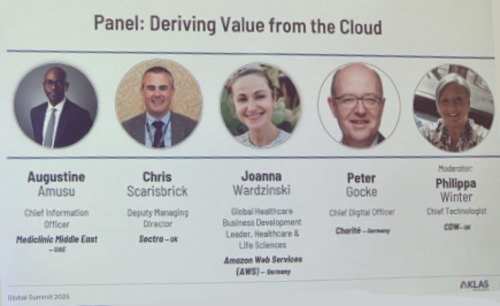
One of the less talked about, but equally transformative topics at the summit was on how healthcare organisations can unlock the true value of cloud technologies. I was privileged to moderate an expert panel on the subject. The cloud is no longer just a storage solution; it's a strategic enabler for innovation and efficiency. Here's how healthcare leaders can make the most of it and some of the areas discussed by the panel:
- Financial Operations (FinOps): Effective cloud strategies start with understanding and optimising costs. Adopting FinOps practices can help healthcare organisations maximise their return on investment by ensuring resources are allocated efficiently. This includes tracking cloud usage, avoiding over-provisioning, and scaling services based on demand.
- Skill Transfer and Workforce Upskilling: Transitioning to the cloud requires a workforce prepared for the change. Upskilling teams to manage cloud infrastructures and applications is crucial. It’s about creating a culture of continuous learning while fostering collaboration between IT and clinical staff to harness the full potential of cloud technologies.
- Strategic Placement: Understanding What to Put in the Cloud: Not all workloads are suited for the cloud, so it's vital to evaluate what makes the most sense to migrate. Sensitive patient data may require hybrid solutions for compliance, while analytics workloads or telemedicine platforms often thrive in cloud environments due to their scalability and accessibility.
The cloud, when used strategically, becomes a foundation for agility and innovation in healthcare. By leveraging its potential wisely, organisations can improve operations, enhance patient care, and position themselves for future technological advancements.
Addressing Clinician Burnout
Clinician burnout is a significant issue in healthcare and certainly evident in the NHS. The summit highlighted how digital tools and AI can reduce administrative tasks, allowing healthcare professionals to focus more on their patients. This also promotes better work-life balance and improves staff well-being.
In addition to reducing administrative burdens, technology can help prevent clinician burnout by enabling telemedicine and remote monitoring. These technologies allow clinicians to provide care and consultations without being physically present, thus reducing travel time and scheduling conflicts. Electronic patient records (EPRs) equipped with decision support systems can assist healthcare providers by suggesting treatment options, flagging potential issues, and keeping track of patient information efficiently.
Furthermore, AI-driven predictive analytics can identify early signs of burnout in clinicians by analysing patterns in their workload, performance, and well-being metrics. This allows for timely interventions, such as adjustments to workloads or the provision of mental health resources, before burnout becomes severe.
Implementing continuous professional development and training programs through online platforms can also empower clinicians by keeping them updated with the latest medical knowledge and best practices while providing flexibility to learn at their own pace. These technological advancements collectively contribute to creating a supportive work environment that prioritises clinician well-being.
Harnessing Technology for Preventative Care
Another compelling discussion revolved around the growing emphasis on preventive care in healthcare, powered by cutting-edge technologies. Proactive health monitoring systems, wearable devices, and diagnostic tools equipped with AI are giving patients and providers the ability to act before issues escalate.
Wearable health trackers, for instance, are evolving to offer real-time insights into vital signs and health trends, enabling early detection of anomalies such as irregular heartbeats or oxygen levels. Combined with AI-powered diagnostic algorithms, these devices can guide clinicians toward timely interventions, reducing the burden of chronic diseases and emergency admissions.
Furthermore, predictive analytics is becoming a cornerstone of preventative care. By analysing historical and real-time health data, these systems can identify patterns that signal potential risks, empowering healthcare providers to recommend lifestyle adjustments or treatments tailored to individual needs.
These advancements are not merely about technology; they're about creating a culture of proactive health management. When patients and clinicians work together to anticipate and mitigate health challenges, the result is a healthier, more empowered population.
Patient-Centric Care: Putting People First
Another key theme was making healthcare more personalised and accessible. From telemedicine to mobile health apps, the summit highlighted how digital solutions are empowering patients and transforming how care is delivered. It’s all about engagement and convenience.
These innovations are not just about convenience; they actively foster a deeper connection between patients and healthcare providers. For instance, personalised health tracking tools offer patients a greater sense of control over their health, enabling them to monitor vital signs, medication schedules, and even mental well-being through intuitive platforms. Additionally, telehealth services extend care to rural or underserved areas, breaking down geographical barriers and ensuring that care reaches those who need it most.
Furthermore, patient-centric care is being reimagined through advancements in virtual consultations and AI-driven chatbots, which provide instant answers to medical queries. These technologies work together with human expertise, ensuring that patients feel supported throughout their healthcare journey. By placing patients at the centre of the care equation, this approach builds stronger trust and better health outcomes for all involved.
The Role of Data: Healthcare’s Secret Weapon
I have always highlighted how, big data and analytics are changing the game in healthcare, driving better clinical outcomes and operational efficiency. But here’s the catch: ensuring secure and interoperable data exchange is crucial to unlock its full potential. It’s all about balance!
Data plays a critical role in identifying trends, predicting outcomes, and personalizing patient care. With accurate data, healthcare providers can make informed decisions that enhance treatment plans and patient experiences. Furthermore, data-driven insights help streamline administrative processes, reduce costs, and improve resource allocation.
The importance of secure and interoperable data exchange cannot be overstated. This ensures that patient information is safeguarded against breaches while allowing seamless sharing across different healthcare systems. When data flows freely and securely, it fosters collaboration among practitioners, boosts research capabilities, and ultimately leads to better health outcomes for patients.
Generative and Ambient AI: Game Changers in Healthcare
Generative and Ambient AI are shaking up healthcare. Generative AI helps create personalised content like patient record summaries and treatment plans, cutting down on paperwork for clinical staff. It also supports predictive analytics, assisting clinicians in anticipating patients' needs.
Ambient AI interacts with the environment to make smarter healthcare spaces. Think hospital rooms with AI sensors that monitor patient vitals and alert staff when something's off, all without needing manual input. These techs work behind the scenes, boosting patient safety and making things run smoother.
An integral part of Ambient AI's evolution is ambient voice technology, which allows for seamless voice interaction within healthcare environments. For example, voice-activated systems can enable clinicians to access patient records or input data hands-free, making procedures more efficient and hygienic. For patients, ambient voice systems provide a sense of autonomy by allowing them to control room settings, request assistance, or even access health information through simple voice commands. By fostering a natural, conversational interface, ambient voice enhances the integration of technology into healthcare without feeling intrusive.
Together, generative and ambient AI mean more adaptive and responsive healthcare. From streamlining workflows to unobtrusive monitoring, they're set to transform the field. Embracing these advances can improve outcomes and build trust in digital healthcare.
Take hospital rooms with intuitive sensors as an example. They quietly ensure safety, alerting caregivers only when needed. This shows a future where tech blends with human efforts rather than overshadowing them. AI insights also become a part of clinical decision-making, almost like a natural extension of a clinician’s intuition. The goal isn't just efficiency; it's about creating an experience that combines care, compassion, and precision.
As ambient technologies like voice systems take hold, they become the invisible support system in modern healthcare. Their subtle nature builds trust, keeping the focus on what really matters: improving patient lives.
Digitisation: The Opportunities and Challenges
Outside the summit, digitisation is reshaping healthcare in so many ways. Here’s a quick rundown:
- Better Clinical Decision-Making: Advanced tools and digital records are speeding up decisions and improving patient care.
- Boosted Collaboration: Digital solutions make sure everyone on a care team is on the same page, improving coordination.
- Healthcare for Underserved Communities: Telemedicine is breaking barriers, bringing timely care to rural and remote areas.
- Empowered Patients: Digital health platforms are giving people the tools they need to take charge of their own health.
Of course, challenges like data security, interoperability, and infrastructure need to be tackled to fully realize these benefits. But hey, every revolution has its hurdles, and CDW are here to help.
How CDW UK is Supporting the Healthcare Revolution
At CDW UK, we’re deeply committed to driving meaningful healthcare transformation. Here's how we’re addressing the key opportunities and challenges outlined:
AI That Works
We assist healthcare organisations in identifying and implementing artificial intelligence solutions that are both reliable and ethical. From clinical decision-making to operational efficiency, our AI deployments enhance precision and reduce the likelihood of errors, creating a safer environment for patients and clinicians alike.
Reducing Burnout
Clinician burnout is a pressing issue, and we’re working with our partners to alleviate this challenge by leveraging digital tools that streamline workflows. By automating routine tasks and improving system interoperability, we enable healthcare professionals to focus more on patient care, alleviating undue pressure.
Personalised Care
Through the adoption of telemedicine and mobile health technologies, we’re making healthcare more accessible and convenient for underserved communities and urban centres alike. Patients are empowered to take charge of their health with tools tailored to their individual needs, reinforcing the shift towards patient-centred care.
Secure and Seamless Data
Data security and interoperability remain critical challenges in healthcare transformation. With our expertise in cybersecurity and data integration, we ensure seamless and safe information exchange across systems. Our solutions address infrastructure gaps and foster collaboration among healthcare teams, improving overall patient outcomes.
Empowering Patients
We support digital health platforms that enhance patient engagement, providing tools that enable individuals to actively monitor and manage their health. From wearable devices to health apps, these technologies empower patients to make informed decisions and maintain better lifestyle habits.
The Future Outlook
As digitisation reshapes healthcare, CDW UK stands at the forefront of this transformation. By addressing the challenges of data security, infrastructure, and ethical AI, we’re paving the way for a future that blends compassion, precision, and innovation. Together, we’re striving to improve patient outcomes and create a more connected and efficient healthcare system.
Wrapping Up
Attending a conference such as the KLAS Global Summit always leaves me inspired. Networking with thought leaders from around the world, sharing best practices, celebrating successes, and most importantly, learning from mistakes to avoid repeating them across organisations globally, is invaluable.
The future of healthcare is promising, full of opportunities for innovation, improvement, and empowerment. Digitisation lies at the core of this transformation, and with the support of CDW UK, this transition is both achievable and impactful. Together, we can continue pushing boundaries and shaping the future of care.
I’d be delighted to hear your thoughts. What excites you most about the direction healthcare is taking, and how can we assist you in this journey
Contributors
-
 Phillipa Winter
Chief Technologist - Health & Social Care