Why does it matter for UK organisations?
Digital sovereignty is the degree of control an organisation maintains over its data, operations, supply chain, and AI, enabling it to keep running and adapt as regulation, geopolitics, or technology change.
It is not just a question of where data is stored; it should be considered a business resilience strategy. It matters now for UK organisations because regulation, jurisdictional concerns, and demand for AI-driven infrastructure are all rising simultaneously.
Key takeaways
- Sovereignty is now about control and resilience, not just data locality.
- Modern sovereignty spans four areas: data, operational, supply chain and AI.
- The biggest risk is inflexibility, not failing a compliance audit.
- 73% of UK organisations now treat sovereignty as a strategic priority, up from 61% a year earlier (OpenUK, 2026).
- Act by classifying what genuinely matters, designing for "exit-ability", and treating resilience as one board-level conversation.
Let’s explore how operational complexity has become the new technical debt and where platform engineering takes us next.
What does digital sovereignty actually mean?
Digital sovereignty should be understood as control over the technology your organisation depends on across four interconnected areas. It has grown far beyond its original focus on data location and jurisdiction. Those four areas are:
- Data sovereignty: who controls your data, where it resides, and which legal frameworks apply to it.
- Operational sovereignty: who runs your platforms, who holds privileged access, and where operational control sits when something goes wrong.
- Supply chain sovereignty: how well you understand the dependencies in your technology estate, and how resilient they are to disruption.
- AI sovereignty: how much transparency and control you have over the models, training data and infrastructure behind your operations.
Viewed across all four, sovereignty ceases to be a one-off compliance exercise and becomes an ongoing resilience strategy.
Why does sovereignty matter now, especially in the UK?
Sovereignty matters because three forces are converging: regulation, jurisdiction and AI. The demand is becoming a major topic of conversation, especially in the UK: 73% of UK organisations identified sovereignty as a strategic priority in 2026, up from 61% the year before (OpenUK).
How is regulation changing?
Regulators increasingly expect proof that operations can withstand and recover from disruption, not just that data is protected. In the financial services sector, the EU's Digital Operational Resilience Act (DORA) applies to UK firms serving EU customers and to the technology suppliers that support them. Where control sits in law can matter as much as where data is physically located. The US CLOUD Act can compel US-headquartered providers to hand over data regardless of where it is stored, prompting many boards to reassess who has legal reach over their information. The concern is significant enough that the EU is examining whether the largest cloud providers should be regulated as "gatekeepers” and has backed its own tech sovereignty agenda.
How is AI driving sovereignty?
Traditional applications primarily consumed data. AI systems consume, generate, learn from, and make decisions using that data.
That creates new questions for boards and regulators:
- Where is training data being processed?
- Which country's laws apply to AI-generated outcomes?
- Can sensitive data be used to train third-party models?
- What happens if a cloud provider changes access terms or service availability?
- Can organisations prove where inference is taking place?
As AI becomes embedded in decision-making, governments and regulated industries increasingly view control over AI systems as a national and organisational resilience issue rather than simply an IT architecture decision. Research cited by industry analysts highlights growing concern that dependency on foreign models, infrastructure and providers introduces both economic and geopolitical risk.
While data sovereignty focuses on controlling information, Sovereign AI focuses on controlling intelligence itself. It encompasses four core dimensions:
- Data sovereignty – control over training and operational datasets.
- Compute sovereignty – control over the infrastructure powering AI workloads.
- Model sovereignty – ownership or control of the AI models being used.
- Governance sovereignty – the ability to enforce local policies, regulatory requirements and organisational values
What is the "sovereignty tax"?
The "sovereignty tax" is the cost of being locked into a provider you cannot easily leave. We are finding a growing number of UK organisations feel stuck with providers and pay a premium simply to stay. When switching feels impossible, an organisation has already lost its leverage, regardless of what the contract says.
Does sovereignty look the same in every sector?
No. The pressure takes a different shape by sector:
- Financial services: focused on DORA and uninterrupted critical services.
- Public sector and healthcare: focused on keeping sensitive data and its recovery inside UK jurisdiction, driving demand for sovereign recovery and isolated "clean room" environments.
- Manufacturing: focused on supply-chain exposure and keeping production systems running.
Isn't sovereignty just a compliance requirement?
No. The greater risk is inflexibility, not non-compliance. Compliance is concrete and has deadlines, so it dominates the conversation, but the real threat for most organisations is building themselves into a position they cannot easily change. Ask these questions:
- What happens if the rules change again?
- What happens if a platform's economics move against you?
- What happens if a geopolitical event constrains a key supplier?
- What happens if the AI services you depend on become more limited or costly?
The organisations that do well over the next decade will not be those that predicted every disruption. They will be those who built enough flexibility to adapt when disruption arrived.
Does digital sovereignty mean moving eveything back on-premises?
No. Sovereignty is not a reversal of cloud adoption, and not an argument against the hyperscalers, whose sovereign cloud options are now part of the market. Three myths are worth correcting:
- Myth: sovereignty means repatriating everything. The real question is which workload belongs where, and with what level of control. Public cloud remains central to most operating models.
- Myth: sovereignty is all-or-nothing. Sovereignty sits on a spectrum. Over-classifying everything adds cost and complexity; under-classifying leaves unseen risk.
- Myth: sovereignty is a technology problem. Sovereignty is a business-resilience problem with a technology dimension, which is why it belongs at the board level.
We must also remember that cloud first does not have to mean just leveraging hyperscale cloud, the relevance of hybrid strategies is settling as the norm and use of UK or EU sovereign cloud options, like CDW ServiceWorks Cloud, provide options to consume in a familiar way but remove us Cloud ACT challenges.
How can IT leaders act on sovereignty?
IT leaders should act in three steps: classify what matters, design for choice, and treat resilience as one conversation.
- Classify what genuinely matters. Identify which data is business-critical, which systems are operationally essential, which services create regulatory exposure, and which AI workloads need extra governance. Direct control where it is needed and prioritise flexibility elsewhere. The goal is the right level of control, not the maximum.
- Design for choice ("exit-ability"). Build in the ability to move if a platform becomes unattractive, regulation evolves, or a supplier is constrained. Like a new roundabout built with exits that lead nowhere yet, anticipating a route early is far cheaper than rebuilding later.
- Treat resilience as one board-level conversation. Cyber resilience, commercial resilience and sovereign resilience are connected. Decisions about infrastructure, cloud, AI, and operations affect all three, so manage them together rather than solving one at the expense of another.
None of this requires transforming everything overnight. It requires checking whether the architectural assumptions made five years ago will still serve the business five years from now, and acting on what no longer will.
Cloud sovereignty Framework
Another lens worth investigating is building a Sovereign framework that allows you to assess the impact and value at different levels of sovereign design and deployment. While not perfect, the EU SEAL (Sovereignty Effectiveness Assurance Levels) approach does provide a starting point on how to structure an approach to a framework
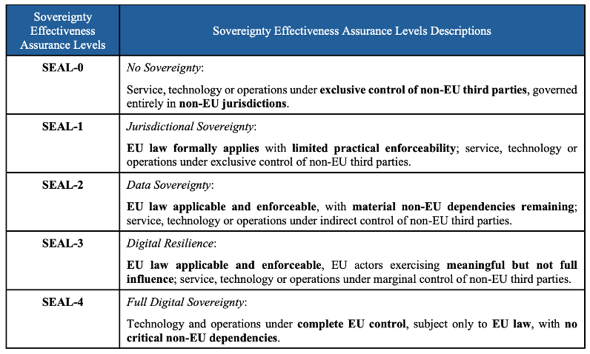
The value of this work completed by the EU lies not in the model itself, but in the methodology it uses to turn a complex and often subjective topic into something measurable, assessable, and repeatable.
The first step is to identify the strategic outcomes that matter most to your organisation. Rather than focusing solely on data location, a holistic digital sovereignty model should consider governance, legal control, operational independence, technology choices, supply chain resilience, security, and long-term sustainability. These become the foundational pillars of the framework
Once the pillars are established, each should be supported by measurable criteria. The framework demonstrates how high-level objectives can be broken down into tangible assessment areas, including ownership and governance, jurisdictional exposure, control of encryption keys, operational self-sufficiency, technology openness, supplier transparency, and compliance assurance. This creates a consistent basis for evaluation and removes much of the subjectivity from the decision-making process.
The outcome should allow your decision makers to understand the pros and cons of aiming for differing levels of sovereignty and the value it does or does not bring.
Full details on the EU approach can be found here.
How does CDW approach sovereignty?
CDW advises independently, working across the whole technology ecosystem rather than defending a single platform. There is a difference between being agnostic and being independent: agnostic means having no opinion, while independent means having the freedom to give one.
CDW works through four questions with each organisation:
- What genuinely needs sovereign protection, and what does not?
- Can workloads and operations adapt if circumstances change?
- Can the organisation provide evidence of where the data sits, who has access, and how it is governed?
- What should the future operating model look like?
The aim is a design that fits the organisation and can be defended to a regulator, a board, and a customer, rather than a single template applied to everyone. That is the standard to keep in view.
FAQ
Is digital sovereignty the same as data residency? No. Data residency (where data physically sits) is one part of sovereignty. Sovereignty also covers operational control, supply chain dependencies, and AI.
Does sovereignty mean leaving the public cloud? No. Public cloud remains central. Sovereignty is about assigning each workload to the appropriate level of control.
Which regulations are driving sovereignty in the UK? DORA (in force from January 2025 and applicable to UK firms serving the EU), the UK Cyber Security and Resilience Bill (introduced in late 2025), and jurisdictional concerns around the US CLOUD Act.
What is "exit-ability"? Exit-ability is the ability to move a workload or change provider if commercial, regulatory, or supply chain circumstances change. Designing it early is far cheaper than retrofitting it later.
Where should an organisation start with sovereignty? Classify what is genuinely critical, decide where control is needed versus where flexibility matters, and treat cyber, commercial, and sovereign resilience as a single board-level conversation. Start there and keep returning to the balance between control and flexibility.
Contributors
-
 Rob Sims
Chief Technologist - Hybrid Platforms