As we move into 2026 (and through to 2030), it feels like we are on the brink of several new technology waves that could drive meaningful transformation for many organisations. From AI to quantum computing and connectivity paradigms driven by sensing network fabrics, the opportunities promise to be transformational. The challenge, as usual, will be getting out of pilot phases and into production. This will enable us to validate the real-world proof points and drive broader investment.
For many organisations, focusing on foundational activities such as controlling technical debt, unlocking data, and mapping critical business processes (the only way to unlock AI value) will be the key priorities for 2026 and 2027. Setting themselves up to take advantage of the trends impacting the market in the coming years. For others, it will be about pushing the boundaries and being the pioneers of the new innovations, allowing their organisations to differentiate and grow. The most challenging task will be for those technical leaders who need to deliver both simultaneously. The role of the CIO and CTO will never be more critical and challenging than over the next 3 years.
Quick look back at 2025
Before we look at my thoughts for 2026, I always think it’s good to look back at what I expected to see over the course of 2025. In early January 2025, I introduced the following ten trends to the world as themes I believed would be top of mind for digital leaders. Based on conversations with customers and partners throughout 2025, I estimate that approximately 70% of the list was accurate.
-
Adoption of the Intelligent Edge
-
Unified Observability
-
Artificial Intelligence FoMO
-
Cyber Resilience Maturity
-
Evolved Data Strategies
-
Innovation-Based Returns
-
Zero Trust Adoption
-
Network Digital Twins
-
Skills Gaps
-
AI Developers (DevEx)
For a deeper dive into last year’s list, you can see the post from January 2025 here.
Looking back also allows me to consider how best to present information like this in the future. A single list of trends can be helpful if they align with your current technical or strategic roadmap. If they don’t, it can be challenging to determine when and how to incorporate them into your plans.
Key Themes
This year, I am going to break it down a little differently. First, I want to establish three key foundational imperatives, each with three strategic priorities that will be framed against. I will then provide six themes that can be used to help deliver against the three foundational imperatives.
Throughout the year, I will revisit the three foundations and develop actionable outcomes, ensuring we maintain a focus and an actionable plan for 2026.
#1 Build a Platform for Modernisation
By 2029, Gartner predicts that more than 50% of enterprises will not get the expected results from their multi-cloud implementations. This is a sad statistic and equates to a straightforward outcome: wasted investment. Hybrid Cloud architectures are going to be the standard, but we must make them a product of deliberate thought, not a result of circumstance or accident.
The applications, processes and customer expectations of the previous decade are going to be turned upside down in the coming decade. The need to balance innovation and the pace of delivery against cost stability and security will require a different approach. The era of containers, AI, data and real-time 'everything' won’t wait or be affordable on the static platforms running today.
We must build a new architecture that can flex, adapt and meet the requirements the future of your organisation will demand.
#2 Digital Resilience Is Now Business Resilience
Cyber Recovery is often treated as insurance, not a core requirement. Yet every ransomware attack, storage failure or misconfigured cloud backup directly impacts business continuity, compliance, and trust.
While many regulated industries are familiar with legislation such as DORA and the mandates it brings regarding resilience, most organisations are not held to such requirements. The challenge we face going into 2026 is that of a society that is increasingly reliant on digital systems to function. Failure of seemingly 'simple' digital platforms can have significant impacts on day-to-day life, from banking failures, mobile network outages and airport downtime that puts massive pressure on day-to-day life. This does not consider the business financial impact, as a recent study suggested that connectivity outages cost us over $17 billion in 2023.
Every organisation is now a digital business and should be looking to regulations like DORA to build internally binding compliance policies. Those who ensure the organisation can survive the inevitable and continue to operate with an acceptable amount of disruption. This must become a core mandate for every technical and process design decision from now on.
#3 The Network as a Strategic Enabler
The network should be transparent to the consumer (your users and customers), delivering consistent and high performance for all, at all times. This is the required standard for the modern digital worker who relies on applications and data distributed across a hybrid landscape.
Networking is often seen as a commodity, but poor connectivity and failures can cause direct revenue, continuity, or productivity impacts. We must treat the network as the foundation of organisational performance and ensure programmability, observability and resilience. None of the innovations of the next decade will function without the network. Now is the time to lay the foundations to underpin the next decade of transformation.
Strategic Priorities
Every time we frame a new technology project or strategy, we can align it to the three foundations outlined above, while measuring its impact against the following three strategic priorities.
-
Operational Simplicity: Drive simplicity, make the system autonomous and self-healing
-
Security Everywhere: Baked in, not bolted on, at every layer without compromise.
-
Economic Discipline: Run workloads on the right platforms to deliver commercial longevity
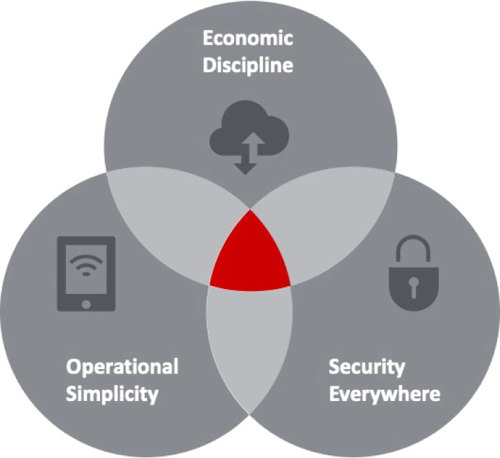
We should ask, does the project align with an imperative, and does it drive one of the strategic priorities? Two simple questions to help drive all projects towards a common north star. Tie this to a multi-year strategy, and we can start to create a direction that is bigger than individual people and can withstand the inevitable personnel changes.
2026 Themes
Of course, a list of themes for 2026 could easily be 20-30 items long, especially if we look to cover all the technology areas that Hybrid Platforms incorporates. The following six have been curated to cover the broadest range of organisations and sectors. I hope that each can help drive the goals set out in the previous section.
Digital Twins Everywhere
Digital twins are often misunderstood as niche engineering tools useful for physical assets but irrelevant to core IT. Many IT operations remain largely reactive, with teams relying on monitoring rather than simulation, and detecting faults only after an outage has occurred.
As hybrid estates grow, spanning on-premises, edge, and cloud, the number of dependencies becomes impossible to visualise, leading to change-related outages that impact service levels. Without digital replication of infrastructure and data flows, teams can’t predict how changes will affect performance, availability, or resilience. This limits planning accuracy, drives costs up, and increases risk. The result is a constant cycle of firefighting rather than foresight.
Over the past couple of years, we have seen the technology for creating digital twins of networks, applications and business processes mature. Gartner predicts that through 2028, organisations using network digital twins to model their configuration and software/firmware updates will reduce their unplanned outages by up to 70%.
Operations teams need investment in digital twin technology to ensure, at a minimum, they can maintain SLA in the escalating complexity of a hybrid world. At best, we can hope for significant improvement in uptime and overall service quality.
AI Reimagined
Despite record investment in artificial intelligence, many organisations still sit in pilot purgatory! Chatbots, analytics experiments, and isolated proofs of concept rarely transition into production operations.
The most significant barrier is integration: AI isn’t embedded into the infrastructure or workflows that run the business. As a result, operations remain manual, repetitive, and dependent on human judgment for every decision. In hybrid environments with thousands of dependencies, this human bottleneck leads to inefficiency and increased risk.
Meanwhile, AI models require high-quality data and context to act reliably, something most enterprises still lack. Without embedding intelligence directly into systems, AI remain a great idea that misses its true potential.
Generative AI has provided a fantastic foundation for the true future value generator, Agentic. While it is still growing in adoption, the potential for agentic AI outstrips anything we have seen over the previous three years.
To clarify, I view Agents and Agentic as two distinct outcomes. Agents can help people achieve tasks faster; true agentic systems should have a level of autonomy and replace or augment critical business processes. Both are extremely valuable, but for different reasons.
This is why I say in 2026, we are looking at AI reimagined. Pilots will transition to production, and Agents and Agentic outcomes will provide the opportunity to transform core functions. But only for those organisations that release three key things:
-
It’s about augmenting or replacing processes, not deploying technology
-
Data is key, time to get it sorted
-
Don’t attempt that list of 100+ AI 'ideas'. It won’t work; focus on the four that will transform the core of your organisation.
Resilience by Design
Many organisations treat resilience as insurance rather than a fundamental architecture.
Disaster recovery plans exist on paper, but the hybrid reality that spans multiple clouds, on-prem systems, and third-party dependencies can make them unworkable in practice. Cyber incidents now cascade across supply chains and connected services more quickly than manual responses can cope. Traditional backup strategies no longer meet RPO/RTO expectations, and few businesses test recovery end-to-end. The result is fragile resilience and confidence without capability. Every disruption exposes weaknesses between IT, security, and operations teams that were never truly integrated.
We also live with a false sense of safety, thinking a traditional DR plan is likely to survive a cyber-attack. Concepts like Minimal Viable Company (MVC) and Cyber Recovery Time Objectives (CRTO) must become the standard for every organisation as soon as possible in 2026. Without updated planning, mindsets, processes, and technologies, we will continue to see the number of breaches escalate. As noted above, every organisation is now a digital business and must adapt in accordance with its reliance on technology.
Eliminating Strategic Debt
Decades of transformation have created fragmented ecosystems, layers of tools, platforms, and processes that can reflect leadership turnover or the impact of hype, more than strategic design.
Every new CIO inherits a patchwork of partial migrations, redundant licences, and incompatible systems—strategic debt compounds when governance resets with every reorganisation. The outcome is slower innovation, higher cost, and demoralised teams maintaining systems no one truly owns. Without continuity of intent, transformation becomes perpetual, rather than progressive, burning cash and culture simultaneously.
Organisations need to create a “living architecture” that is evolving yet stable, supported by an institutional memory that survives leadership change. With an average of 30% of IT budgets consumed on technical debt management and 20% of resources allocated to servicing it, the opportunity to drive cost savings and impact our economic discipline warrants a detailed examination during the early parts of 2026.
Observability Economics
Most UK organisations now practice some form of FinOps. They produce cloud spend reports, track budgets, and run optimisation sprints. Yet, very few connect that financial insight to what’s happening inside their infrastructure, which leads to a scenario of numbers without narrative.
Without unified observability, FinOps can become a blind accounting exercise, capable of showing what was spent, but not why. Costs can spike, and teams can’t see whether it’s driven by latency, traffic surges, configuration drift, or inefficient code.
Conversely, observability platforms generate terabytes of telemetry but rarely translate that activity into financial impact. This disconnect means neither side can take meaningful action; engineers see performance issues but can’t quantify the business cost impact, while finance sees overspend but can’t trace it to its operational cause or effect.
Linking actual observability practices (not just monitoring) with a mature digital cost management practice (the new iteration of FinOps will be Digital Cost Management) can help align the needs of different leaders, such as the CIO, CFO, and COO.
Data Sovereignty & Federation
Across every sector, data has become abundant; however, there remains a lack of ability to leverage its measurable value. Most organisations are swimming in disconnected datasets, legacy databases, cloud silos, SaaS platforms, and edge systems. Yet few have a coherent view of what they hold, how it connects to business value, or what it’s worth.
Data engineering teams spend more time searching for information than using it. Analysts duplicate effort, business users question accuracy, and leaders lose confidence in their dashboards. The challenge isn’t lack of data; it’s the lack of structure, trust and context needed to turn it into insights and innovation.
Instead of chasing “one big lake,” we are seeing forward-thinking organisations creating federated data fabrics that let data stay where it lives but remain searchable, governed, and ready for analytics or AI training. This connected layer, known as a knowledge layer, helps turn chaos into clarity: metadata reveals what’s available, lineage shows how it’s used, and automation ensures continuous compliance.
Final Thoughts
2026 promises to be an exciting year, and I look forward to reviewing this list at the end of the year to see how it holds up against reality. I believe it will be a challenging year as we tackle the above against a backdrop of macro-economic challenges. However, the potential for transformation presents an opportunity to mitigate this risk.
One major challenge we all need to be aware of is the impact on the semiconductor industry. An overview of the challenges is shown below. Please discuss with your account team the development of a mitigation plan tailored to your specific needs.
Overview
Across the semiconductor industry, all leading manufacturers are signalling ongoing supply constraints and extended lead times for key memory components:
-
Samsung Electronics reported record-high quarterly sales in its Memory division, driven by AI-related demand for HBM3E and server SSDs. The company stated that “demand for memory chips for the global AI infrastructure build-out will far outstrip supply.”
-
SK hynix announced that shipments of high-capacity DDR5 modules have “more than doubled quarter-on-quarter” and that discussions with key customers for 2026 HBM allocation are now complete, confirming “tight supply conditions through next year.”
-
Micron Technology stated in its FY2025 Q4 report that “industry DRAM supply remains tight, with elevated demand for HBM and DDR5 memory driven by AI deployments,” noting that “supply-demand conditions are expected to remain favourable for suppliers well into 2026.”
These statements reinforce a consistent industry outlook: AI demand is significantly exceeding memory production capacity, with HBM and DDR5 supply already fully allocated by Tier 1 manufacturers for much of 2025 and early 2026.
Expected Market Timeline
Late 2025 – Mid 2026: Peak period of shortage and price pressure.
Mid 2026 – Mid 2027: Gradual recovery as additional fab capacity comes online.
Late 2027 – 2028: Expected stabilisation of supply and pricing conditions.
Contributors
-
 Rob Sims
Chief Technologist - Hybrid Platforms