Supply Chain Notice


In earlier parts of the Hybrid Platforms Trends Series, we delved into our Platform of the Future vision. We touched on the three foundational components of Hybrid Cloud: Secure Networking and Data Protection. We will now unpack the details of the Hybrid Cloud foundation and look at how we can deliver a platform to support all application and data requirements. Part one will explore the challenges, while part 2 explores the solutions and outcomes.
Everything your organisation does starts with applications and data; these are the lifeblood of every process, product or service offered. This is why choosing the optimal platforms to host these critical assets is paramount to future success. With optimal technology choices, organisations can leverage data as a foundation for decision-making, driving change and delivering exceptional customer experiences.
Our Hybrid Cloud team is focused on helping tackle a range of challenges that we have seen prevail across our diverse customer base. The ten challenges below highlight the complexity facing IT decision makers in today's application and data-driven landscape. We believe a new mindset is required to ensure we don’t continue the same cycle of challenges.
- Complexity of Integration between differing vendor solutions
- Consistent Cross-Platform Data Management
- Providing unified Governance and Control
- Outdated Workforce Skills and Expertise
- Preconceived ideologies aligned with legacy capabilities
- Networking and Connectivity Complexity
- Disaster Recovery and Business Continuity Implications
- Keeping Pace with Rapid Technology Evolution
- Continuous need to blend Innovation with Stability
- Cloud vs. On-Premises vs. Hybrid Decisions
Challenging the preconceptions:
As these eras evolved, two polar opinions became prominent: those that believed in on-premises and those that championed hyperscale cloud providers. During this time, the concept of ‘Cloud First’ evolved, in many cases, to mean ‘Cloud Only’, leading to workload migrations that should never have occurred.
Many organisations swapped infrastructure management overheads for FinOps overheads in the face of escalating cloud consumption bills. This, in turn, opened the door for cloud repatriation conversations and increased confusion about the correct platform: Cloud or On-Premises.
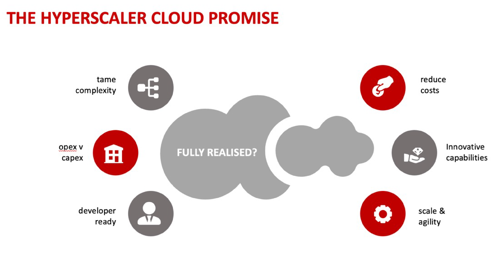
One of the core tenets of our Hybrid Cloud strategy is to help organisations realise the full benefits that the public cloud has promised over the past decade. We define these promises as the following six principles:
- Provide OpEx vs. CapEx options
- Be developer-ready
- Reduce operating costs
- Unlock Innovative Capabilities
- Provide scale & agility
- Tame operational complexity
We recognise that this won't be a binary outcome in many organisations. Some workloads will operate at peak effectiveness in the Public Cloud, while others will contribute to bill bloat.
For most organisations, this will mean blending Edge, Private and Public cloud capabilities and adopting a unified cloud operating model that spans all environments. First, we can deploy evolved private cloud and edge computing capabilities to utilise modern capabilities that will alleviate historical operational challenges. Secondly, we can optimise public cloud operating models to take advantage of native capabilities, reducing spend and increasing developer velocity. By using the best of each technology, we can create a more optimal cost base that still delivers the speed and agility.
Evolving Demands:
Historically, building these applications and data platforms has been a challenging process, and over the past 15-20 years, we have seen several significant shifts in prevailing technology strategies. The move from physical to virtual servers defined the ‘virtual machine’ era and enabled significant resilience and cost consolidation benefits. The evolution to the ‘dev-centric’ era drove the adoption of public cloud, which accelerated as traditional IT architectures became overly complex. Platform demands are now rapidly evolving as we enter the ‘Data & AI’ era. At the same time, Edge use cases have driven innovation in infrastructure technologies, while Artificial Intelligence is redefining data requirements and where workloads are best executed. All this is coupled with escalating demands on the importance of Data and its power to help drive better decision making.
Legacy Systems and Technical Debt
Over the past couple of decades, we have seen organisations accumulate increasing mountains of technical debt. Fuelled by constantly changing strategies, the cost of replacing legacy systems, and accelerating demands. All this debt places a heavy burden on operations teams and often means organisations are forced to maintain technical compliance in all the eras mentioned above. This stretching of the technology landscape within an organisation presents significant security risks and cost challenges, and it threatens to stifle innovation and impact the consumer experience. For many, it will be a multi-year Journey to a more unified and simpler architecture, so the sooner we start, the faster the future will arrive!
A Level Set on Terminology
One thing that will help drive decision makers’ thinking in tackling these challenges is ensuring everyone is using the same terminology. For this reason, we break down the hybrid cloud space into four areas:
- Enterprise IT: This is the time-tested data centre deployment model that is static and siloed. For most organisations, this is not considered an acceptable operating model for the future.
- Next-Gen Data Centre (NGDC): A highly automated and virtualised environment deployed and managed through code to offer simple operations and generally optimised for running virtual machines and storing large data sets.
- Cloud Operating Model: Leverage the cloud operating model mindset across the hyperscale providers and as an augmentation to a next-generation data centre. Delivering on-demand anywhere services with a focus on modern application development.
- Intelligent Edge: Combining IoT, Edge Computing and Artificial Intelligence to collect and leverage data at source, delivering enhanced decision making and increased time to value.
If you are an organisation running off-the-shelf applications in virtual machines, then an NGDC is likely to offer the most effective platform. For those developing and deploying modern applications or needing to add services rapidly (to meet demand or location), adopting a cloud operating model should be the goal. The critical point is leveraging the right platform for the right outcome.
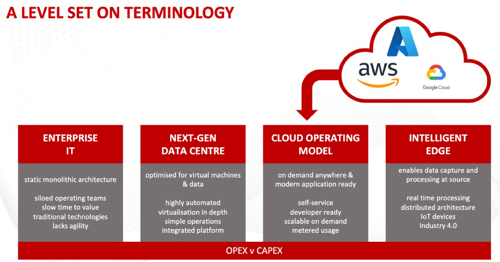
The final point is that the OPEX v CAPEX conversation should not be tied to any of these outcomes; the options to pay for services in the desired manner are now pervasive, allowing the decision to be decoupled.
The Future is Hybrid
Balancing the evolving demands on infrastructure, cloud vs. on-premises, technical debt, and decreasing budgets is the real challenge for all IT decision-makers. We believe the future is hybrid and by combining evolved private infrastructure technologies, edge computing and public cloud services under a cloud operating model.
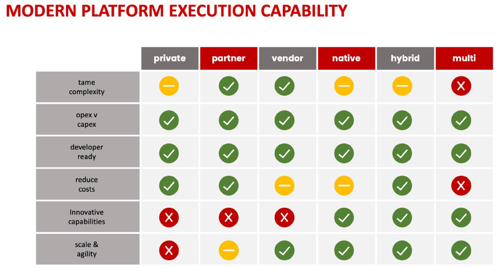
If we map the cloud promises from earlier to the ever-increasing types of cloud, we can start to make more informed decisions. First, let’s define the terms:
Private: This is the Next Gen DC from above, combined with automation and developer capabilities, a public cloud running in your facility or co-location.
Partner: a private cloud operated by a partner, like CDW ServiceWorks Cloud.
Vendor: Hypervisor Vendors’ solutions running in the hyperscaler facilities, Microsoft AVS or Nutanix NC2 are examples.
Native: Running fully in one hyperscaler cloud with all native tooling and processes.
Hybrid: A Combination of the previous types, but working under a single operating model
Multi: A Combination of the previous types but working via different and isolated operating models
Now, we can map these into a matrix and examine the capabilities of each combination to help inform the high-level outcome. One core challenge we see repeated is a lack of alignment between decision makers on the outcomes or benefits of a particular technology choice. Ultimately, this leads to someone not realising the expected benefits and the potential for yo-yo strategies that fuel technical debt and complexity.
Conclusion
Our belief is that the future is hybrid and that technology in both the public and private cloud ecosystems has evolved significantly over the past two years. The evolution has opened new opportunities for optimisation and, in some cases, a chance to update long-term strategies to align with modern capabilities. In Part 2 of this article, we will dive into the components of the modern hybrid cloud and how they combine to increase velocity while controlling costs and improving security.
Contributors
-
 Rob Sims
Chief Technologist - Hybrid Platforms