As we look back over 2026, there is a lot to ponder about how AI and, importantly, Agentic AI is going to impact customer priorities and outcomes. At CDW, we think everything should focus on three key areas;
1. How do we increase Revenue
2. How to we decrease cost and manage risk
3. How do we deliver exceptional customer experience?
We truly believe that Agentic AI will outstrip the previous 2 years of Generative AI’s ability to impact these three outcomes. We will get to the 7 key principles later in this article, but without context, we could end up on the wrong road. So, let’s go on a short journey.
Generative AI Assistants, AI Agents, and Agentic AI
Before we get into the how and what of AI in 2026, there is something we think needs to be clarified first - Assistant? Agent or Agentic? There are important differences, and the hype can blur the lines somewhat.
Generative AI Assistants: These are your reactive responders; they generate content or answers only when prompted by a user and work within a defined scope. They excel at producing text, code, images, and similar outputs, but do not act independently. This is the technology we have been experiencing as ‘AI’ for the last 2-3 years, and its capabilities continue to accelerate. But it has a single-core limitation: it needs constant direction and instruction.
AI Agents: Are task-oriented and resemble a subject matter expert in your organisation. When we add context, like an HR Agent or a Finance Agent, it makes more sense. An agent can perform specific tasks autonomously once given a direction by a human. Unlike an assistant, an agent can typically interact with external tools or APIs and carry out multi-step procedures to achieve the given goal. However, agents still operate under human-defined rules and goals. They are more proactive than assistants: for example, an AI agent could be told, “Find and book the cheapest flight from X to Y,” and then query travel APIs, filter results, and book a ticket according to predefined criteria. This level of autonomy really starts to deliver value by saving meaningful time. The limitations remain the scope and how it will interact with other agents.
Agentic AI: This is your autonomous goal seeker. Agentic AI refers to AI systems with a degree of self-directedness in achieving outcomes. They don’t just follow a single preset workflow; they can set and adjust their own sub-goals in pursuit of a broader objective and potentially dynamically adapt to the environment. Think about linking that HR Agent to the Finance Agent and another 10 SME agents and allowing them to take ‘ownership’ of a business process. The potential is significantly greater than that of first-generation assistants. In essence, an agentic AI is like a digital “employee” or problem-solver: it perceives context, develops a plan, executes multi-step actions, monitors results, and can change course as needed, typically with minimal human intervention.
Assistant: Creates content in response to a specific question or request.
Agent: SME in a certain task and can complete the task with some level of autonomy
Agentic AI: A system of Agents working in collaboration and with autonomy to achieve a stated outcome.
Understanding the differences, though they might seem subtle, is critical to ensuring you are using the right ‘tool’ to solve the business challenge. Whilst the evolution over the past couple of years has been from Assistants to Agentic, it does not mean that assistants are not the right answer for the right problem. This also does not address the fact that Predictive AI outcomes (not generative) and simple RPA or automation remain core capabilities for solving critical challenges.
Hype vs Reality: Why the Terms Get Mixed Up
Misunderstanding AI capabilities: Some non-technical leaders come to believe that AI can “just do everything automatically.” For example, hearing terms like autonomous or self-driving suggests you can set an AI loose on a business process and have it re-engineer it entirely. Conversely, FUD can lead to a mindset that AI is not ready, thereby underestimating its capabilities; this is the current AI paradox.
Underestimating risks and effort: The other challenge of hype is that it can imply that AI systems are fully smart and “know what they’re doing.” Leaders might not realise the amount of governance and training needed. Most of this is in data preparation and process transformation, not AI deployment.
Mis-timing investments: The hype cycle can pressure organisations to adopt AI prematurely or with unrealistic timelines. Boards hear that competitors are embedding AI everywhere, and they fear missing out. As noted above, it can also lead people to think the next big thing will be the answer and never get started. Both are equally risky.
Focus on the wrong metrics: The market often touts broad benefits (“increase efficiency by 50% or completely transform customer experience!”). This can create unrealistic expectations for ROI. Non-IT executives may look for immediate big wins, without understanding that AI adoption usually starts with small, specific improvements that accumulate over time.
The buzz around AI, with terms like agentic, autonomous, cognitive, and self-driving, has created inflated expectations among many leaders. It’s easy to mistake a “chatbot that can answer questions” with “an AI that can run an entire job function”.
This confusion can lead to misalignment between C-suite expectations and what teams on the ground can implement
That said, the real-world outcomes of semi-autonomous Agentic AI deployed over the last 12 months have been truly game-changing, particularly in process transformation and core business efficiency.
The State of Agentic AI Deployment Today
How far along are companies in using these technologies? Most organisations are still in the early stages of adopting true agentic AI. Many have deployed generative AI assistants (think chatbot help, coding assistants) and are experimenting with semi-autonomous agents, but few have scaled fully autonomous AI across the enterprise. We believe that Assistants should be the table stakes for every frontier firm today, and that everyone should be exploring the core Agentic outcomes that can make a meaningful difference to the organisation. We can think of adoption across three horizons:
Experimental pilots: These are small-scale trials, often run by innovation teams or IT, to test feasibility.
Assisted or human-in-the-loop deployments: Here, the AI system performs real work with human oversight at key points. Think of this as “co-pilot on steroids.
Fully autonomous, production-grade deployments: This is where digital businesses need to be focusing in 2026, building solutions where the AI agent operates end-to-end in a live process with minimal or no human intervention, in real time.
Key constraints holding back faster adoption of agentic AI
As we look back on 2025 and 2026, five key factors come to mind that explain why we are not seeing faster adoption (outside the hype cycles mentioned above). Tackling these challenges will require focus from a cross-functional team with a singular focus on improving business processes and optimising experiences.
1. Data and context limitations: Agentic AI needs extensive context to make good decisions, including access to knowledge bases, databases, and real-time data feeds. Many pilots failed to scale because the agent was operating with incomplete information or context.
2. Trust and oversight: Many businesses remain cautious about letting agents run loose. As a result, they deliberately limit scope or require human approval, which can slow down potential gains. This is a sensible, understandable approach, as no one wants a media story created by an AI disaster.
3. Technical maturity: The tooling for building and managing agents has been maturing rapidly. Early adopters often had to cobble together solutions, while 2026 offers a more mature collection of frameworks.
4. Governance and security readiness: We will discuss this more in the next section, but suffice it to say, few organisations had a referendum architecture to call on for managing autonomous agents.
5. Alignment to ROI: We are still seeing a significant disconnect between the ask to invest in the technology and its connection to tangible ROI.
Principles for a Successful Agentic AI Adoption Journey
So now we know where we have been and where we should and could be going, how do you take that journey? The following 7 principles should help guide you in building your AI CoE and realising meaningful value.
1. Start with Strategy and Business Value
Tenet: Tie Agentic AI initiatives to specific business outcomes and pain points.
One of the biggest challenges is focus: its not about the 200 use cases it about focus on the top 3-5 things that will really move the needle? Focus on those and deliver the ROI. Then you can expand with the confidence of the business. Stop chasing the 200 use cases; most are distractions and will likely be easier to deploy in the future.
2. “Crawl, Walk, Run” – Gradual Autonomy with Human Oversight
Tenet: Adopt a phased approach: incrementally increase autonomy as you gain confidence.
Start with the foundations, rooted in generative assistants and build out towards more autonomous outcomes. When connected to the business value, the returns will be visible.
3. Build Strong Governance and Ethical Guardrails
Tenet: Implement robust governance from the outset, don’t bolt it on later
Building against a robust framework will help drive compliant adoption that won’t scare your legal team or land you in regulatory hot water. Think about:
-
Clear accountability
-
Policies and ethics
-
Operational guardrails
-
Security measures
4. Data Readiness and Architecture
Tenet: Prepare your data and IT architecture to support AI agents
Data, Data, Data, you have heard it before in relation to AI, and you will hear it again, but for good reason. The old garbage-in, garbage-out still applies; just now, we have garbage-in, accelerated garbage-out. The other attached element is ensuring your platforms are ready to support AI workloads.
5. Upskill Your People and Update Processes
Tenet: Prepare your workforce and workflows for collaboration with AI agents
Technology, People and Process, it's not a new trio, but it's certainly very relevant to the AI adoption curve. The Process element could be the single most important aspect of accelerating Agentic AI adoption. We cannot start with tech; it will lead to significant wasted investment. Think about:
-
Training and Change Management
-
How to redefine roles and processes
-
The need to promote a collaborative mindset
6. Risk Management and Ethical Use
Tenet: Embed risk management and ethics review into the AI project lifecycle.
We know this overlaps with governance, but is worth emphasising from a leadership perspective. Risk is evident in all technology, but the pace at which it can be exposed with AI is infinitely greater. Don’t overlook your approach in this space.
7. Architecture and Modular Design Matter
Tenet: Design your Agentic AI solutions in a modular way with clear interfaces and fallback plans.
Design a system where each part can be updated or replaced without breaking everything, allowing you to pick the wrong tool or change direction as new ones emerge. This modular approach means you don’t need to wait for the perfect outcomes; start moving now and grow the value over time. Think about three layers:
-
A core intelligence layer, the data and the LLMs that will do the heavy lifting
-
A set of tools or skills that the agent can use and interact with
-
An orchestration layer that manages the interactions, identity, etc
Conclusion: Navigating the Journey
AI promises powerful outcomes: systems that not only answer our questions but also actively solve problems and carry out tasks in collaboration with us. We are very excited about what the future holds and how we can leverage Agentic AI to fundamentally change the way organisations operate.
For senior leaders, especially outside of IT, the key is to approach this technology with both optimism and pragmatism.
-
Recognise the differences between simple assistants, more capable agents, and true autonomous Agentic AI.
-
Beware of marketing myths. Cut through the buzzwords by asking questions that link back to outcomes your board or investors should care about.
-
Focus on people and process as much as technology. The organisations that get ROI from AI are those that re-imagine workflows and train their people to work alongside AI.
-
Ensure ethical and responsible use. In an era of fast-moving technology, reputation and trust can be fragile. Proactively addressing governance helps avoid public noise and builds confidence with customers and your own teams.
Finally, we urge everyone to maintain a balanced perspective but get moving now so you don't miss out on the opportunities AI can deliver today. Also, look to avoid both false negatives and false positives in your view of AI’s value.
-
A false positive would be believing AI can do something it can’t (yet), leading to wasted resources or costly pilots.
-
A false negative would be dismissing the real opportunities or delaying action until “the perfect solution” arrives, potentially losing competitive advantage to more proactive actors.
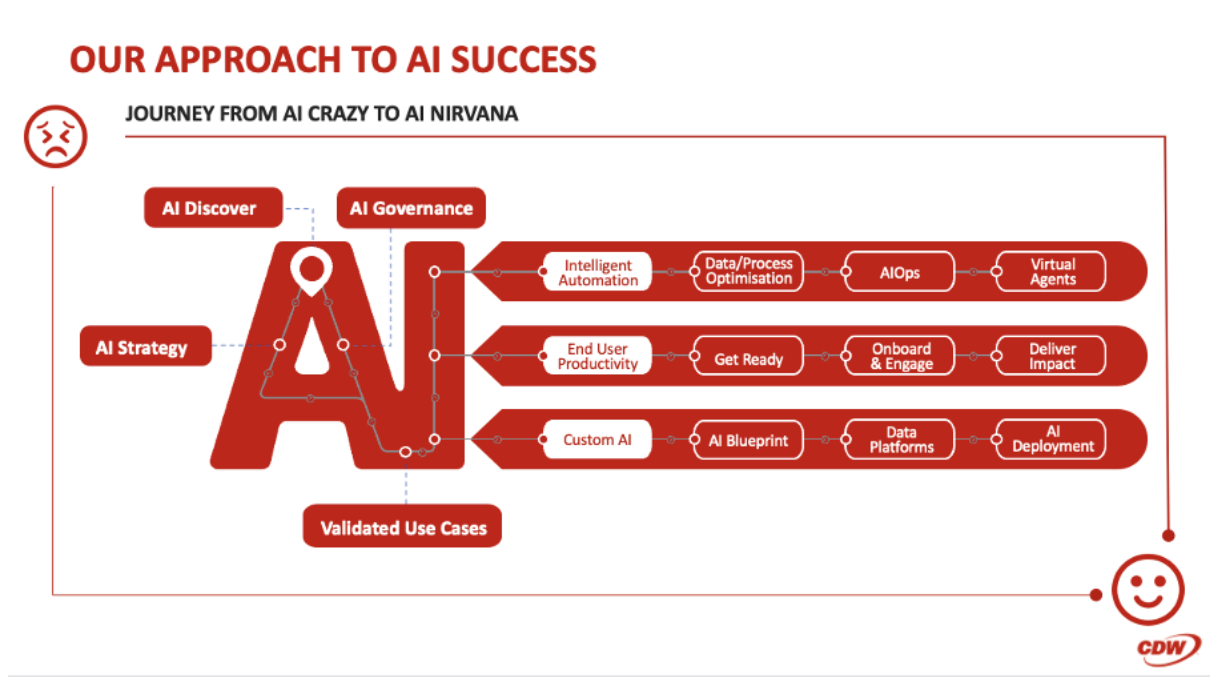
All this is why we created our AI Crazy to AI Nirvana Journey, which allows us to bring the right skills and expertise to augment your teams, whatever stage of maturity you are currently at. From executive-level alignment to the development of full Agentic systems, our teams are ready to assist.
CDW AI Crazy to Nirvana: A curated journey to Accelerated AI Outcome